What Is DV in Nutrition and How to Use It on Food Labels
Daily Value (DV) is a guideline based on a 2,000-calorie diet that shows how much a nutrient in one serving contributes to your daily needs. You’ll find %DV on food labels, helping you quickly spot high or low amounts of key nutrients.
Aim for higher %DVs in beneficial nutrients like fiber and vitamins, and lower in things like saturated fat. If you want to make smarter choices and balance your diet effectively, there’s more to explore.
What Is Daily Value (DV) and Why It Matters
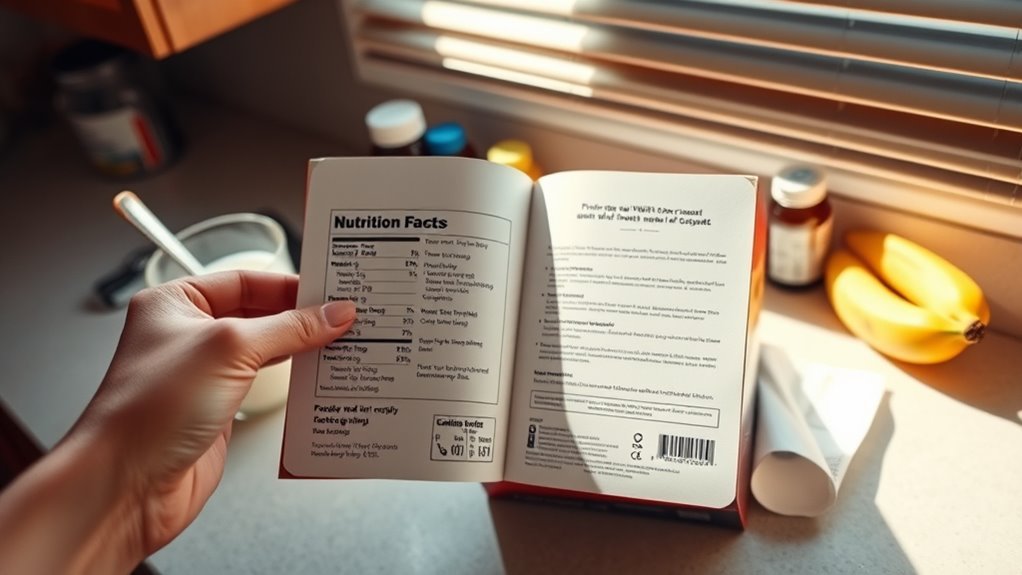
Although you might not always notice it, the Daily Value (DV) on food labels plays a crucial role in guiding your nutrient intake. The DV is a reference amount of nutrients, based on a 2,000-calorie diet, that helps you understand how much of each nutrient one serving provides toward your daily nutritional needs.
Found on most nutrition labels, the DV shows you whether a food is high or low in essential nutrients like vitamins, minerals, fiber, and fats. By using the DV, you can compare different products more easily and make smarter food choices that align with dietary guidelines.
Food labeling with DVs offers a straightforward way to track your nutrient intake and maintain a balanced diet. When you check the DV on nutrition labels, you’re better equipped to meet your nutritional needs without guessing, helping you stay on top of a healthier lifestyle.
How to Read % Daily Value (%DV) on Food Labels
When you look at the % Daily Value (%DV) on a food label, you see how much one serving of that food contributes to your daily nutrient needs based on a 2,000-calorie diet. The percent daily value helps you understand if a nutrient is high or low in that serving.
Generally, 5% DV or less means the nutrient is low, while 20% DV or more means it’s high. You can use the %DVs on food labels to compare foods and make healthier choices.
For nutrients you want more of, like fiber and vitamins, look for higher %DVs. For nutrients to limit, such as saturated fat and sodium, aim for lower %DVs.
Keep in mind that Daily Values are general guidelines, so your personal needs might differ. By paying attention to %DV, you can better manage your nutrient intake and select foods that support your health goals.
How Serving Size Affects Your Daily Value Intake
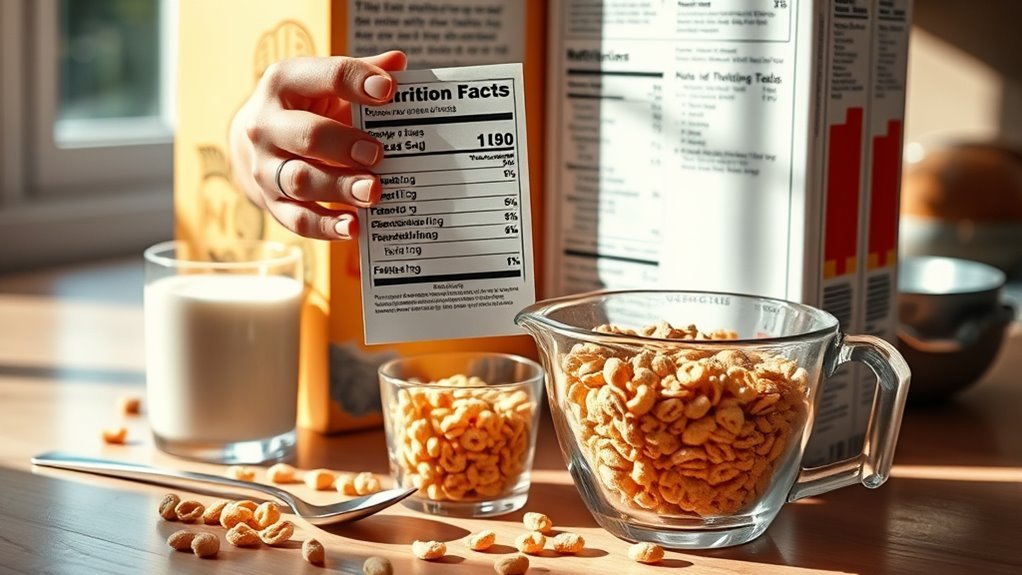
Because the serving size on a food label sets the foundation for the % Daily Value (%DV) calculations, understanding it is key to managing your nutrient intake. The serving size defines the portion of food that the listed %DV refers to, so if you eat more or less than that, your nutrient intake changes accordingly.
For example, if a product shows 10% DV for calcium per serving, eating two servings doubles your intake to 20%. Paying close attention to serving size helps you accurately track how much of each nutrient you consume, aligning with your dietary needs.
Practicing portion control by adjusting serving sizes lets you better manage nutrients you want to limit or boost. Food labels provide this essential information, enabling you to make informed choices. Ultimately, knowing the serving size guarantees that your Daily Value intake reflects what you actually eat, helping you maintain a balanced diet.
Which Nutrients Must Appear on Nutrition Facts Labels
To help you make informed food choices, nutrition facts labels must list specific nutrients required by law. These mandated nutrients include total fat, saturated fat, trans fat, cholesterol, sodium, total carbohydrate, dietary fiber, total sugars, added sugars, and protein.
Furthermore, the label must show vitamin D, calcium, iron, and potassium, both in quantity and as a % Daily Value. This information helps you understand how much of these essential vitamins and minerals you’re getting from the food.
While manufacturers can voluntarily add other vitamins and minerals, only these nutrients are legally required to appear on the label. If a product contains added nutrients or makes health claims about certain nutrients, those must also be listed on the label.
Why Don’t Some Nutrients Have a %DV? What You Should Know
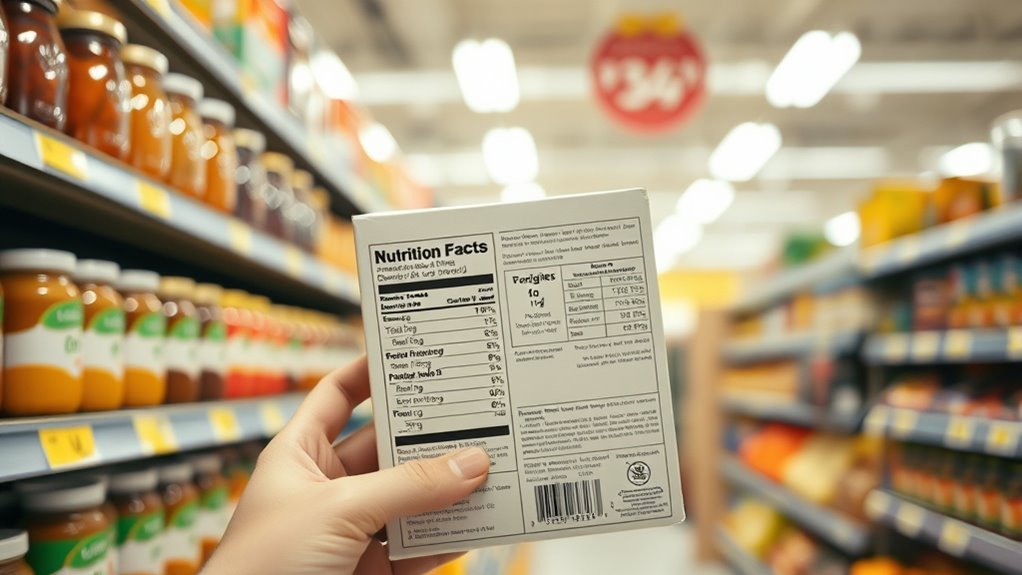
You might notice that some nutrients, like trans fats or protein, don’t have a % Daily Value on labels. That’s usually because it’s easier to track their intake in grams, or simply because there isn’t an official daily guideline for them. So, paying attention to the grams instead of the %DV can actually help you get a clearer idea of how much you’re consuming.
Nutrients Without %DV
Why don’t some nutrients have a %DV on food labels? It’s because of regulatory decisions and the nature of certain nutrients. Nutrients without %DV, like protein, vary widely in individual needs, making a fixed percent daily value impractical.
Trans fats and total sugars also lack a %DV since you’re meant to limit their intake, not increase it. Instead, these nutrients are listed in grams, helping you compare amounts across foods easily.
When you see no %DV, focus on the grams or milligrams provided to make informed choices. Understanding these exceptions helps you better use food labels to manage your diet, especially since nutrients like trans fats are generally discouraged for health reasons and total sugars should be consumed in limited amounts.
Reasons For Missing %DV
Although many nutrients display a % Daily Value (%DV) on food labels, some don’t because their intake is better understood in grams or milligrams rather than percentages. You’ll notice certain nutrients lack a %DV due to how they’re assessed or regulated. For example:
Protein and trans fats are measured in grams, as their dietary impact isn’t suited to percentage comparison. The FDA omits %DV for trans fats since it’s best to minimize or avoid them altogether.
Total sugars don’t have a %DV because grams offer a clearer dietary assessment. Some vitamins and minerals use voluntary %DV, but others lack established guidelines.
This absence helps you focus on grams and overall nutritional quality rather than just percentage numbers on food labels.
Using Grams Instead
Since some nutrients don’t have a % Daily Value (%DV) on food labels, you’ll need to focus on the grams listed to understand their impact on your diet. Nutrients like protein and trans fats lack a %DV because their recommended daily intake varies or isn’t standardized.
Instead, you compare these nutrients by grams on the nutrition label and use dietary guidelines to assess your intake relative to the serving size. Checking grams on food packaging helps you manage your daily intake more precisely for those nutrients without a %DV.
| Nutrient | %DV Present? | How to Use on Label |
|---|---|---|
| Protein | No | Track grams per serving size |
| Trans Fats | No | Minimize grams consumed |
| Total Sugars | No | Monitor grams, no %DV |
| Fiber | Yes | Use %DV for daily intake |
Using %DV to Identify Nutrients to Limit or Increase
When you check the % Daily Value (%DV) on food labels, you can quickly spot which nutrients you should limit or increase in your diet. The DV helps you identify nutrients to limit, like saturated fat, sodium, and added sugars, by looking for a %DV of 5% or less.
On the other hand, nutrients to increase, such as dietary fiber, vitamin D, and calcium, usually have a %DV of 20% or more, signaling a good source. Using %DV allows you to make nutrient comparisons across foods, helping you pick healthier options that align with your dietary goals.
Here’s how to use %DV to guide your choices:
- Choose foods with low %DV (5% or less) for nutrients to limit
- Look for high %DV (20% or more) for nutrients to increase
- Compare %DV across similar products for better nutrient balance
- Select options with favorable %DV values to support your health goals
This way, the Daily Value becomes a practical tool for smart eating.
Tips for Using Daily Value to Make Healthier Food Choices
To make healthier food choices, start by focusing on the % Daily Value (%DV) listed on labels. Use the DV to quickly spot nutrients you need to limit or increase. For example, aim for 5% DV or less of sodium and saturated fat, while choosing foods with 20% DV or more of fiber, vitamin D, or calcium. This helps you align your selections with your dietary goals.
Always compare foods using %DV to pick options that fit your nutrition needs best. Keep in mind, some nutrients like protein or trans fats don’t have a %DV, so check grams or other info instead. Also, pay attention to portion size on food labels since %DV is based on a standard serving.
Balancing your intake by monitoring the DV ensures you get enough beneficial nutrients without overdoing less healthy ones. Using these tips, you can make smarter, healthier choices every time you shop or eat.
Frequently Asked Questions
How Are Daily Values Determined for Different Age Groups?
You determine daily values by following dietary guidelines that consider age-specific needs and nutrient requirements. Health experts adjust calorie amounts and nutrients based on development stages, ensuring nutritional diversity across age groups.
They also factor in health considerations and population differences, like pregnancy or childhood. This way, your daily values reflect your body’s unique demands, helping you meet appropriate nutrient intake as you grow or age.
Can %Dv Be Used for Diets Other Than 2,000 Calories?
You can’t fit every diet into the same mold; %DV dances differently depending on your calorie intake. When you customize your diet, you need to adjust %DV to match your unique nutrient needs, health goals, activity level, and age considerations.
Special diets and dietary restrictions require you to interpret these values thoughtfully, ensuring your choices truly support your body. So, use %DV as a guide but tailor it to your life’s rhythm.
How Often Does the FDA Update Daily Value Percentages?
The FDA updates Daily Value percentages irregularly, not on a fixed schedule, to reflect new nutritional guidelines and your changing calorie requirements. These updates consider nutrient absorption and dietary restrictions, helping you with accurate food labeling and portion sizes.
Are Daily Values the Same Worldwide or Just in the U.S.?
Imagine scanning a colorful food label, but the numbers don’t add up the same way everywhere. Daily Values aren’t uniform worldwide. They reflect regional differences shaped by unique dietary guidelines, cultural variations, and health policies.
While international standards aim for clarity, labeling regulations differ, making global consistency tricky. So, when making nutrition comparisons, be aware that DVs you see in the U.S. might not match those on products abroad.
How Does %Dv Apply to Vitamins and Minerals Supplements?
You use %DV on vitamin and mineral supplements to gauge supplement dosage and nutrient synergy. It helps you understand how much of a nutrient you’re getting, considering vitamin absorption and mineral bioavailability.
This is essential if you have dietary restrictions or want to address nutrient deficiencies efficiently. Supplement labeling with %DV also guides you in evaluating health claims and choosing supplements that fit your personal needs.
Conclusion
Now that you know what Daily Value (DV) means and how to use %DV on food labels, isn’t it easier to make smarter choices? By paying attention to serving sizes and %DV, you can quickly spot nutrients to limit, like sodium and added sugars, or those to boost, like fiber and vitamins.
Using this simple tool helps you take control of your nutrition and build healthier eating habits every day. Why not start checking your labels today?