
How Are Macronutrients Located on a Nutrition Label?
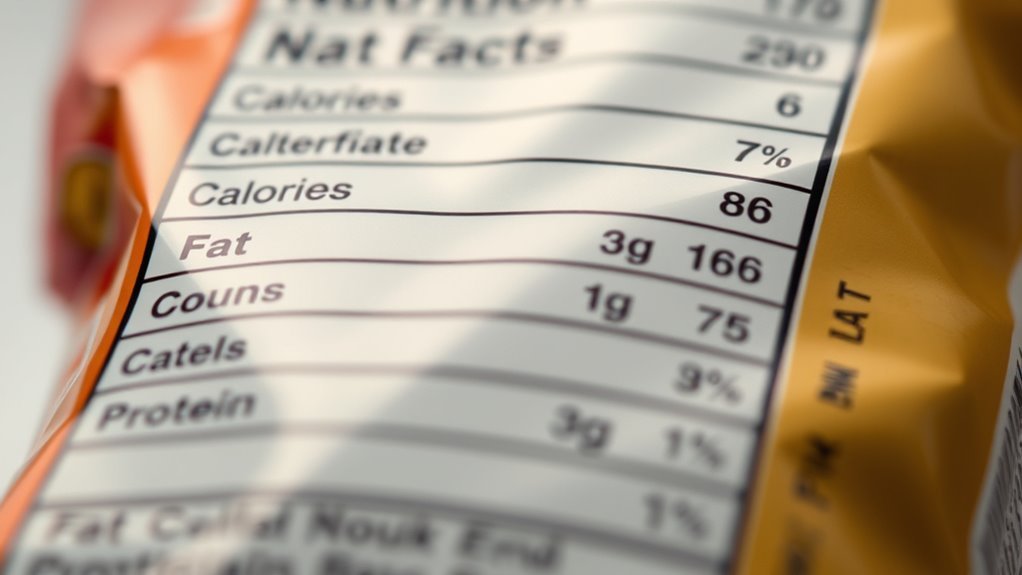
You’ll find macronutrients like carbohydrates, fats, and proteins grouped prominently near the top or center of nutrition labels for easy spotting.
Total fats often break down into saturated, trans, and unsaturated types, while carbohydrates include fiber and sugars, sometimes separating added sugars.
Macronutrient amounts appear per serving, usually alongside calories, helping you compare and control portions quickly.
As you explore more, you’ll uncover how layout variations and % Daily Value make nutritional decisions even clearer.
Macronutrient Layout on Nutrition Labels

When you check a nutrition label, you’ll usually find macronutrients like total carbohydrates, proteins, and fats listed prominently for easy reference. The layout places total carbohydrates near the top of the nutrition label’s nutrient section, often followed by details such as dietary fiber and total sugars.
Proteins appear close by, clearly marked in grams per serving size, making it easy to understand how much protein you’re getting per portion. Total fats are also listed, frequently broken down into saturated fats, trans fats, and sometimes monounsaturated and polyunsaturated fats.
This organized layout helps you quickly evaluate the energy and nutrient contributions of the food. By presenting macronutrients in a clear, consistent order, nutrition labels guarantee you can make informed choices about your diet without confusion.
You won’t have to hunt for these key details since the nutrition label’s design puts them front and center, reflecting their importance in your daily nutrient intake.
Understanding Percent Daily Value (%DV) on Nutrition Labels
Nutrition labels don’t just list macronutrients; they also include the Percent Daily Value (%DV). This tells you how much a nutrient in one serving contributes to your daily diet based on a 2,000-calorie intake.
The %DV helps you quickly see if a food is high or low in specific nutrients. Five percent DV or less means low, while 20% DV or more means high.
This standardized scale from 0 to 100% makes it easier to compare foods and understand their nutrient content.
Total Carbohydrates: Dietary Fiber and Sugars Explained
When you look at the total carbohydrates on a label, you’ll notice that dietary fiber and sugars are listed separately. Dietary fiber is great because it helps with digestion and keeps you feeling full longer.
Now, it’s also important to understand the difference between natural sugars and added sugars. Added sugars are the ones you want to limit for better health. So, keeping an eye on those can really make a difference!
Dietary Fiber Benefits
Why should you pay close attention to dietary fiber on nutrition labels? Dietary fiber is a type of carbohydrate found in plant foods that plays a vital role in your digestion. When you check the total carbohydrate count on a nutrition label, dietary fiber is included but offers unique benefits.
Consuming enough fiber daily, about 25 to 38 grams, can help lower cholesterol and stabilize blood glucose levels. This supports overall health. Fiber also promotes feelings of fullness, which helps control your appetite and manage weight.
Paying attention to dietary fiber helps you make smarter food choices. Look for items labeled “high in fiber” or “good source of fiber” to meet your daily needs. So, use the nutrition label to prioritize fiber-rich carbohydrates for better health outcomes.
Types Of Sugars
How do sugars on nutrition labels affect your daily intake? When you check the total carbohydrate section, you’ll see sugars and dietary fiber listed separately. Sugars include both naturally occurring sugars in fruits and dairy and added sugars from sweeteners or processing.
It’s important to monitor added sugars since they should make up less than 10% of your daily calories. Total sugars give you an overall idea of the sugar content, but watching added sugars helps manage your health better.
- Total carbohydrates include dietary fiber and sugars.
- Sugars consist of naturally occurring and added sugars.
- Dietary fiber supports digestion and heart health.
- Added sugars have no daily recommended limit but should be limited.
- Total sugars and dietary fiber are listed separately for clarity.
Why Added Sugars Are Listed Separately
Because added sugars can substantially impact your health, nutrition labels separate them from naturally occurring sugars to make monitoring easier. On food labels, you’ll find a distinct line for added sugars that helps you identify how much processed sugar is included beyond what naturally occurs in ingredients.
This transparency is essential because many processed foods like syrups, honey, and snacks contain added sugars that boost the overall sugar content. By seeing added sugars separately on the nutrition label, you can better track your intake and stay within dietary guidelines, which recommend limiting added sugars to about 10% of your daily calories.
This clear distinction empowers you to make informed, healthier choices and avoid hidden sugars that might otherwise go unnoticed. Ultimately, listing added sugars separately on food labels supports your efforts to reduce health risks associated with excessive sugar consumption and promotes a more balanced diet.
Protein Information on Nutrition Labels
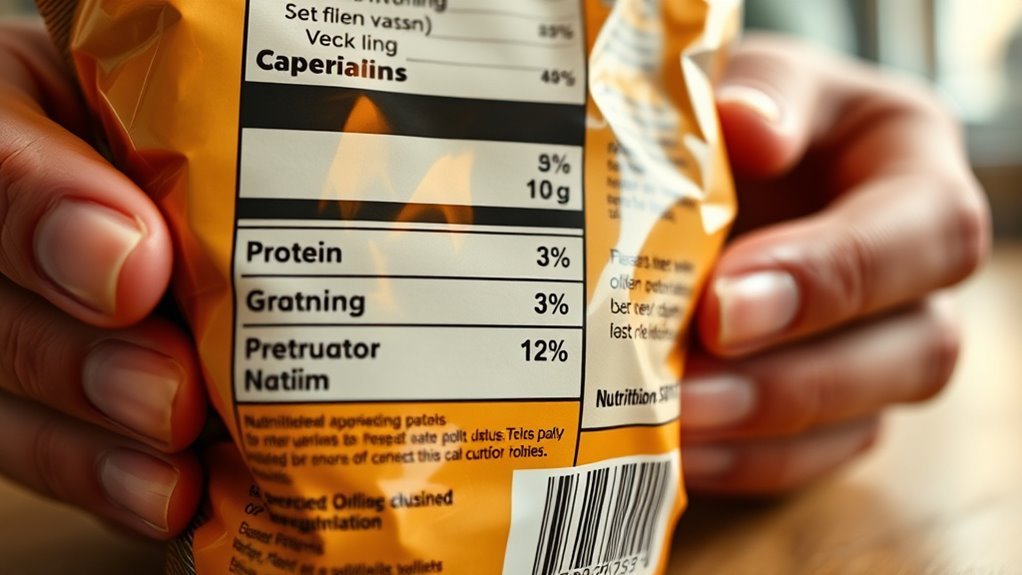
Monitoring added sugars gives you insight into one part of your diet, but protein plays a different and equally important role. On a nutrition label, protein content appears in grams, helping you see how much of this essential macronutrient is in your food products.
While the Percent Daily Value (%DV) for protein isn’t always shown, it appears when a product claims high protein or targets infants and young children. Protein supports muscle repair, cell growth, and overall body functions, so tracking it helps you meet your dietary needs.
Here’s what you need to know about protein on nutrition labels:
- Listed in grams per serving size
- Often near carbohydrate and fat info
- %DV shown for specific protein claims or children’s foods
- Varies widely between different food products
- Helps you compare protein content across items
Understanding protein info on labels lets you make informed choices about your macronutrient intake.
Total and Saturated Fat on Nutrition Labels
When you check nutrition labels, you’ll usually see total fat listed first. Right after that, there’s saturated fat along with its % Daily Value. It’s a good idea to pay attention to saturated fat because it can raise your LDL cholesterol, which affects your heart health. Knowing how to read these numbers makes it easier to make smarter choices that work for your dietary needs.
Total Fat Overview
How can you quickly gauge the fat content in packaged foods? Start by checking the total fat on the nutrition label. It’s listed in grams and as a percentage of your daily value (%DV).
Right below total fat, you’ll find saturated fat, highlighted separately to help you monitor your intake. Trans fat is also listed if present, though many products now show zero due to regulations.
This clear layout helps you understand both the quantity and quality of fat in your food.
- Total fat appears first on the nutrition label
- Saturated fat is shown separately for heart health awareness
- Trans fat is included if present, often listed as zero
- Fat content is measured in grams and %DV
- The label helps you make informed food choices quickly
Saturated Fat Impact
Why should you pay close attention to saturated fat on nutrition labels? Saturated fat is listed separately, usually below total fat, with its amount in grams and % Daily Value (%DV).
The nutrition label helps you track how much saturated fat you consume daily. This is important since exceeding 20 grams can raise LDL cholesterol, which increases your risk of heart disease.
Most guidelines recommend keeping saturated fat below 10% of your total daily calories, and this is reflected in the Daily Value on labels. By monitoring saturated fat, you can make heart-healthier choices and better balance your total fat intake.
Knowing the saturated fat content on a nutrition label lets you control your diet to support overall cardiovascular health.
Label Reading Tips
Paying attention to saturated fat on nutrition labels is just the start of making heart-healthy choices. When you check the total fat and saturated fat values on food packaging, always note the serving size to understand how much you’re consuming. The % Daily Value (%DV) helps you quickly gauge if the fat content is high or low.
Also, watch for “zero trans fats” claims since trans fats add unhealthy fats and are often included in total fat.
Here are key label reading tips:
- Compare grams and %DV of saturated fat for better choices
- Look for “light” or “reduced” fat versions with lower %DV
- Check serving size to avoid underestimating fat intake
- Avoid products with high %DV (20% or more) of saturated fat
- Confirm “zero trans fats” to minimize harmful fat intake on the nutrition label
How Serving Size Affects Macronutrient Values
Because the macronutrient values on a nutrition label are based on the serving size listed, changing that serving size directly impacts the amounts of carbohydrates, fats, and proteins you consume.
When you adjust the serving size, say from half a cup to a full cup, the macronutrient values and calories per serving increase accordingly. Food labels provide nutrient amounts per serving, so understanding this serving size impact helps you accurately track what you’re eating.
If you eat more than one serving, you’ll need to multiply the macronutrient values by the number of servings to get your total intake. This makes portion control essential; eating extra servings means consuming more calories and macronutrients than you might realize.
Common Variations in Nutrition Label Layouts for Macronutrients
Although nutrition labels share common elements, you’ll notice variations in how macronutrients are displayed depending on the product and label format. Macronutrients like total carbohydrates, proteins, and fats usually appear in the main section of the Nutrition Facts label for quick visibility. However, label layouts differ based on design variations and food packaging.
Nutrition labels vary, but macronutrients like carbs, proteins, and fats typically appear prominently for easy reading.
Here are some common differences you might encounter:
- Macronutrients are often grouped near the top or center of the label for easy reference.
- Some labels break down fats further into saturated, trans, and unsaturated types beneath total fat content.
- Dual-column layouts show macronutrient amounts per serving and per package, especially for larger containers with multiple servings per container.
- Placement of macronutrients can be alongside or near calorie information for better comparison.
- The overall design may adjust based on the product’s packaging size and regulatory requirements.
Understanding these variations helps you quickly locate macronutrient info on any Nutrition Facts label.
Tips for Using Macronutrient Info to Make Healthier Choices
You can use the % Daily Value (%DV) to quickly compare nutrient levels between products and make smarter choices. It’s a handy way to see what you’re really getting. Balancing your intake of carbohydrates, proteins, and fats helps support your overall health. So, keep an eye on these numbers to find the right mix that fits your dietary needs.
Comparing Nutrient Percentages
When comparing nutrition labels, paying close attention to the Percent Daily Value (%DV) lets you quickly gauge how much a food contributes to your daily intake of carbohydrates, proteins, and fats. The %DV helps you compare macronutrients across products, making it easier to identify if a food is high or low in specific nutrients. Knowing this lets you make smarter food choices tailored to your health goals.
Here’s what to keep in mind when using %DV to compare macronutrients:
- A %DV of 5% or less means a low amount of the nutrient
- A %DV of 20% or more means a high amount
- Compare %DV to choose foods lower in saturated fat and added sugars
- Look for higher %DV in dietary fiber and protein
- Use %DV to balance nutrient intake throughout your day
Balancing Macronutrient Intake
Balancing your macronutrient intake starts with understanding the information on nutrition labels and using it to make deliberate choices. Check the grams of carbohydrate, protein, and fats per serving size to compare similar products effectively.
Use the % Daily Value (%DV) to assess if a food is high or low in each macronutrient. Aim for lower %DV in saturated fats and added sugars, and higher %DV in protein and dietary fiber.
Don’t forget to guarantee total calories to ensure your energy intake matches your personal goals. By adjusting your intake based on macronutrient distribution, like choosing lean proteins or fiber-rich carbs, you can create a balanced diet that supports overall health and weight management.
Balancing Macronutrients for Better Nutrition Decisions
Although nutrition labels can seem overwhelming at first, understanding how to balance carbohydrates, proteins, and fats lets you make smarter food choices. By focusing on macronutrients listed on the nutrition label, you can tailor your meals to support a balanced diet.
Pay close attention to serving size, as all values, including total carbohydrate, protein, and fat intake, are based on it.
To balance your macronutrients effectively:
- Check the total carbohydrate content, including fiber and sugars.
- Note the protein amount and its percent daily value (%DV).
- Review total fat and its subcategories like saturated fat.
- Compare serving sizes to match your dietary needs.
- Use the nutrition label to adjust portions for a balanced diet.
This approach helps you decide if a food fits your nutritional goals and supports better nutrition decisions every day.
Frequently Asked Questions
How Are Macronutrients Digested and Absorbed in the Body?
You digest macronutrients using digestive enzymes like amylase, proteases, and lipases, breaking them down into glucose, amino acids, and fatty acids. These nutrients get absorbed primarily in the small intestine’s absorption sites.
Enzyme activity and gastrointestinal health greatly impact how efficiently you absorb these nutrients. If you have enzyme deficiencies, digestion slows down. Once absorbed, nutrient transport through your bloodstream or lymphatic system delivers them to cells for energy and metabolic pathways.
What Is the Role of Micronutrients Compared to Macronutrients?
You might think micronutrients are just tiny, unimportant players, but they actually pack a punch! Their functions include boosting nutrient absorption and acting as antioxidants to protect your cells.
Vitamins and minerals play vital roles in energy metabolism and immune support, while trace elements prevent deficiency symptoms that could harm you. So, compared to macronutrients, micronutrients are the unsung heroes keeping your body running smoothly and healthily.
How Do Macronutrient Needs Vary by Age and Gender?
Your macronutrient needs change due to age-specific dietary guidelines and gender-based nutrient requirements. During adolescence, developmental nutrition needs spike, while hormonal influence on intake affects adult men and women differently.
Life stage dietary adjustments matter because older adults experience age-related nutrient absorption changes. You’ll notice gender differences in metabolism require varying protein, fat, and carbohydrate amounts.
Understanding these shifts helps you tailor your diet for ideal health throughout your life.
Can Macronutrient Ratios Affect Athletic Performance?
Picture your body as a finely tuned engine. Macronutrient ratios fuel your performance. Yes, they definitely affect how you perform.
Carbohydrate timing helps you hit peak energy, while protein quality supports muscle repair. Choosing the right fat types boosts endurance, and nutrient timing optimizes recovery.
Hydration effects combine with metabolic rate to maintain energy balance. Adjusting these factors sharpens your stamina and powers your workouts to new heights.
Are There Health Risks From Consuming Too Much Protein?
Yes, consuming too much protein can pose health risks. Excess intake strains your kidneys during the protein absorption and digestion process, increasing the risk of damage.
High protein from animal dietary sources might raise saturated fat, impacting cardiovascular health. Overloading protein disrupts nutritional balance, leading to digestive issues and dehydration due to metabolic effects.
To stay healthy, balance your protein with other macronutrients and choose diverse sources.
Conclusion
Now that you know how macronutrients are located on a nutrition label, you can read with confidence, choose with clarity, and eat with intention. You’ll understand carbs, fiber, and sugars; spot added sugars; and see how protein fits into your daily needs.
Remember, serving sizes matter, layouts vary, and your choices shape your health. Use this knowledge to balance your meals, fuel your body, and live your best, healthiest life every day.