7 Steps to Use a Food Processor to Chop Vegetables
Start by securely locking the work bowl on a dry, stable base and keep the unit unplugged during assembly. Cut vegetables into uniform chunks, typically 1 to 1½ inches, for even processing. Attach the S-blade safely and lock the lid until it clicks.
Use short pulses to control chunk size, scraping the bowl every few pulses to maintain consistency. Test small batches to avoid over-processing and clean all parts thoroughly after use.
Learn these steps, and you’ll master chopping with precision and ease.
Prepare Your Food Processor Safely
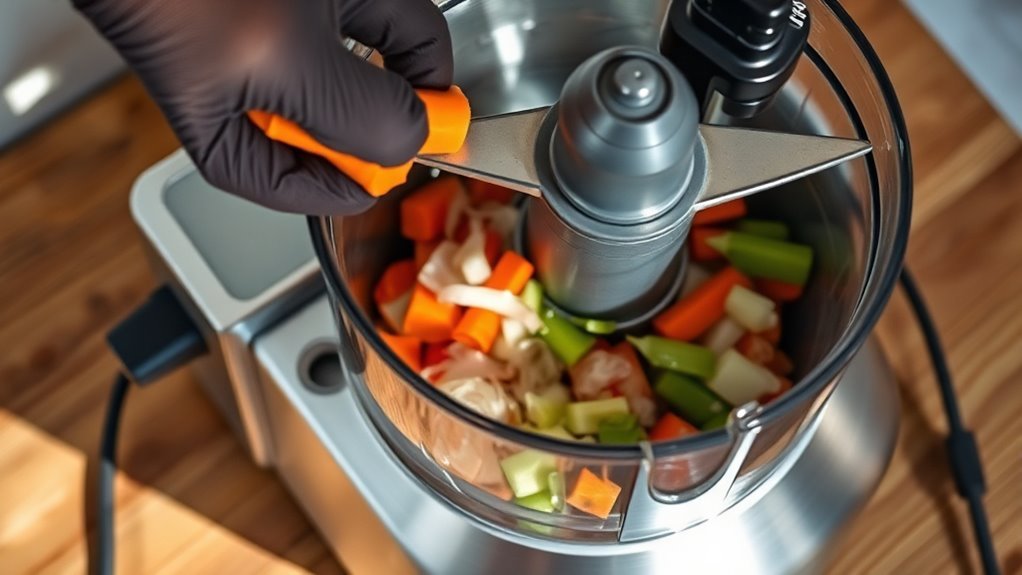
Before you start, make sure your food processor sits firmly on a dry, stable countertop and remains unplugged while you assemble it. First, place the work bowl onto the motor base and lock it securely.
Ensure your food processor is unplugged and firmly placed on a dry, stable surface before assembly.
Next, select the correct blade or disc for chopping and attach it firmly to avoid slips or jams. Then, lock the lid in place along with the feed tube, guaranteeing the safety interlock engages properly. This prevents the machine from running if parts aren’t securely fastened.
Only after confirming everything is locked should you plug in your processor. Remember, never operate the unit with loose or missing parts. Keep your fingers and utensils out of the bowl during use, and always unplug before removing blades or cleaning.
Taking these steps assures your food processor is set up safely and ready to handle vegetables efficiently without risking injury or equipment damage.
Cut Vegetables Into Uniform Pieces
You’ll get the best results when your vegetables are cut into uniform pieces before processing. Using the right tools and techniques helps guarantee even chopping and consistent sizes. So, let’s explore how to prepare your veggies for perfect, uniform cuts every time.
Importance Of Uniform Size
Achieving uniformity in vegetable size guarantees even chopping and consistent cooking results. When you cut vegetables into similarly sized pieces, the processor’s blade meets an equal mass, producing evenly chopped pieces that cook uniformly. This prevents some pieces from being undercooked while others are overdone.
To maintain uniform size, keep these tips in mind: Use the pulse function in short bursts and check frequently to avoid uneven fine bits. Don’t overload the bowl; process in batches filling no more than two-thirds of the work bowl. For firmer vegetables like carrots, par-cook briefly or cut into slightly larger uniform chunks to make certain even tenderness.
Following these steps helps you achieve perfectly chopped vegetables every time.
Techniques For Even Chopping
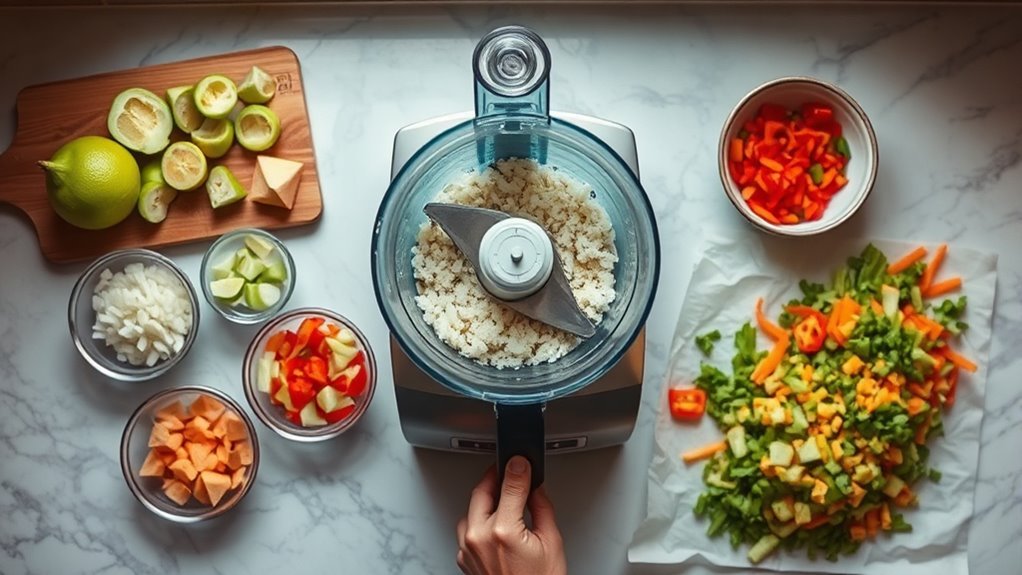
Start by cutting your vegetables into uniform pieces, typically around 1 to 1½ inches for firmer types like carrots or potatoes. This helps your food processor chop evenly, avoiding a mix of large and tiny bits.
Use short pulses of 1–2 seconds, checking and stirring between pulses to guarantee consistency. Don’t overfill the bowl; work in batches filling no more than two-thirds full.
For hard veggies, partially cook them to soften before processing. If your processor has slicing or dicing attachments, use those for uniform pieces.
| Technique | Tip |
|---|---|
| Uniform Size | Cut veggies into 1–1½ inch chunks |
| Batch Size | Fill bowl ≤ 2/3 full |
| Pulsing | Use 1–2 second pulses |
| Attachments | Use slicing discs for cubes |
Tools To Ensure Consistency
Getting uniform pieces begins with the right tools. When using food processors, you’ll want to prep vegetables into consistent starter sizes, like 1 to 1½ inch chunks for carrots or potatoes. This helps guarantee smooth processing and prevents jamming.
The right attachments and techniques help maintain consistency. Use the slicing disc set between 2 and 4 mm thickness, feeding vegetables evenly with the pusher for uniform slices. Work in small, similar-sized batches with the S-blade, pulsing 1 to 2 seconds to monitor size and avoid over-processing.
For diced veggies, slice first, then stack and use a dicing attachment or pulse evenly while rotating the stack for consistent cubes. Keeping harder vegetables cold and cutting into comparable-weight pieces (around 30 to 50 g) also reduces size variance and protects your food processor’s motor.
How to Attach the S-Blade and Lock the Lid
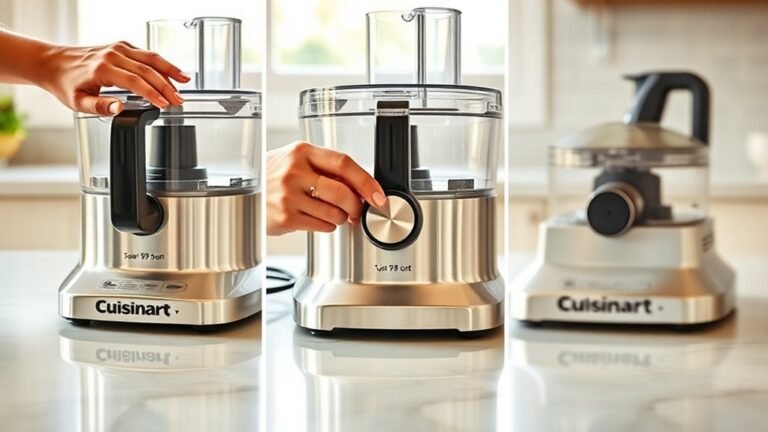
Begin by placing the work bowl onto the motor base, aligning the tabs or arrows, and twisting it until it clicks securely. This step guarantees your food processor is stable and ready for use.
Next, select the S-blade, the perfect tool for chopping vegetables. Hold it by the plastic hub, not the sharp edges, and drop it straight onto the center spindle until it sits flush.
Then, place the lid on the bowl, align the tabs or arrows, and rotate or press down until you hear a safety lock click. This locks the lid securely in place, assuring safe operation.
| Step | Action | Key Point |
|---|---|---|
| 1. Attach bowl | Align tabs & twist | Click confirms lock |
| 2. Insert S-blade | Hold hub, drop on spindle | Avoid sharp edges |
| 3. Lock lid | Align & rotate/press down | Listen for click |
| 4. Verify lock | Brief pulse with no food | Confirms safety interlock |
Always unplug before removing parts to avoid injury.
Use the Pulse Function to Control Chop Size
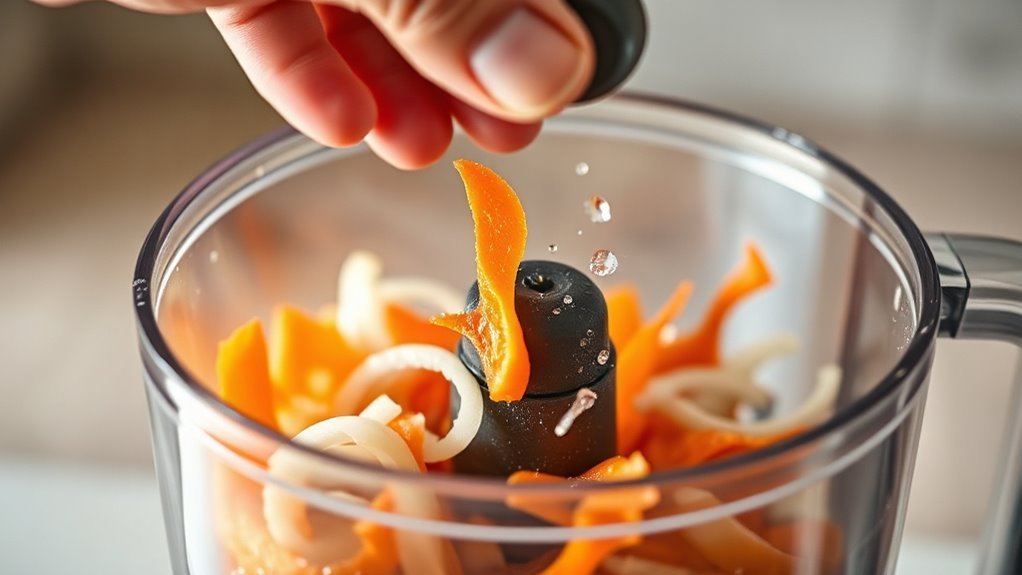
Master the pulse function to control your chop size precisely. Instead of holding down the continuous run button, use short bursts of about one second each. This prevents overprocessing and lets you achieve just the right texture for your food processor recipes.
Remember, always secure the lid and work with small batches, no more than half the bowl, to make sure the blades chop effectively instead of smashing your veggies.
Here’s how to get the best results:
- Pulse 3–6 times for chunkier pieces, using pre-cut chunks no larger than 1–1½ inches.
- Increase to 8–12 short pulses for a finer chop.
- Stop between pulses to check consistency; this helps you avoid over-chopping.
Using the pulse function this way gives you firm, uniform pieces perfect for salads, soups, or stir-fries. It’s a simple trick that makes your food processor recipes turn out just right every time.
Scrape the Bowl Regularly to Maintain Chop Consistency
Regularly scraping the bowl every 10 to 15 seconds helps you maintain an even chop by redistributing larger pieces toward the blades and preventing smaller bits from sticking to the sides. Stop processing briefly and use a rubber spatula to scrape from the rim down to the blade, rotating the bowl if needed.
This guarantees your vegetables, like carrots or potatoes, chop evenly without overprocessing softer items or pine nuts you might add for texture. Remove any stuck bits from the blade and bowl lip between pulses to keep blade contact consistent. Clogged edges cause uneven chopping and puree spots.
For firm veggies, pause and scrape after every 3 to 5 short pulses so you can check chunk size visually before continuing. If you need to clear a jam, always unplug the machine before wiping or reseating the spatula to avoid accidental starts and maintain consistent results throughout your chopping process.
Test and Adjust Chop Size to Avoid Mushy Food
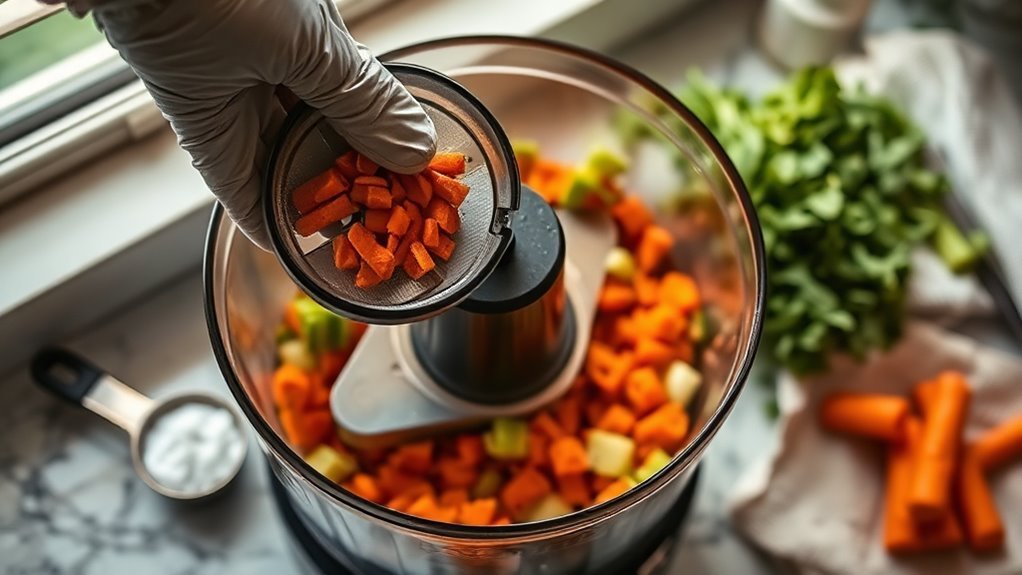
Start by cutting your vegetables into evenly sized chunks. Then, use short pulses on your food processor or chopper to control how finely they get chopped. Keep an eye on the texture between pulses so you don’t end up with mushy pieces.
It’s a good idea to test-cook a small batch first. This way, you can see how the pieces hold up when cooked. If they seem too soft or mushy, just adjust your pulse duration or try cutting the chunks a bit larger next time. Easy!
Control Pulse Duration
You’ll often get the best results by pulsing your food processor in short bursts of 1–2 seconds. Continuous running can quickly turn your vegetables into mush, ruining the texture you want. This is different from making pizza dough, where you need a smooth, elastic consistency.
To control pulse duration effectively:
- Start with 4–6 short pulses for firm vegetables cut into 1/2–1‑inch chunks.
- Shake or stir the bowl every 3–4 pulses to redistribute pieces evenly.
- Add 1–2 more pulses as needed, aiming for slightly larger pieces than your final desired size.
Monitor Chunk Size
Frequently checking the size of your vegetable chunks during processing helps prevent over-chopping and mushy results. Start by cutting vegetables into 1 to 2 inch chunks and use short pulses.
Test a small batch of 2 to 3 pieces after 3 to 4 pulses, aiming for roughly 1/4 to 1/2 inch pieces. Remember, stopping early is key since vegetables break down further during cooking.
If your processor has speed settings or attachments, use the lowest speed or dicing disc for uniform cubes. Scrape and redistribute contents every 5 to 6 pulses to avoid tiny pieces accumulating.
This method assures your vegetables maintain texture, much like avoiding melting ice cream by not over-processing ingredients.
| Step | Action | Result |
|---|---|---|
| Cut chunks | 1 to 2 inch pieces | Even chopping |
| Pulse duration | 1 to 2 seconds, 3 to 4 pulses | Prevent mushy texture |
| Test batch size | 2 to 3 pieces | Check chunk size early |
| Redistribute mix | Every 5 to 6 pulses | Consistent chop size |
Clean and Maintain Your Food Processor
Properly cleaning and maintaining your food processor guarantees it works efficiently and lasts longer. Treating your machine well is a great alternative to buying a new one frequently. After each use, disassemble the work bowl, lid, and blades, then wash them with warm soapy water or place them on the dishwasher’s top rack if your model allows.
Keep your food processor efficient and long-lasting by cleaning its parts after every use.
Always unplug the unit and remove the blade before wiping the motor base with a damp cloth; never submerge it in water.
To keep your food processor in prime condition:
- Dry blades and plastic parts thoroughly before reassembly to prevent rust and bacterial growth.
- Inspect rubber gaskets, locking tabs, and blade edges regularly for damage and replace as needed.
- Store the processor with the lid and blade separate or blade covered to protect cutting edges and avoid odors.
Following these steps will extend your processor’s life and maintain peak performance.
Frequently Asked Questions
Can I Chop Frozen Vegetables in a Food Processor?
Yes, you can chop frozen vegetables in a food processor, but you’ll want to manage their frozen texture carefully. Let them thaw slightly or use partially frozen pieces to avoid motor strain and get cleaner chops.
Pulse in short bursts to control the texture and prevent mushiness. Keep the blade cold to maintain firmness, and avoid overloading the motor with hard, solid blocks. This way, you’ll get well-chopped veggies without ruining their texture.
What Types of Vegetables Are Best for Chopping?
You’ll get the best results chopping firm textures like carrots, potatoes, and raw celery. These vegetables hold their shape well when pulsed, giving you clean, chunky pieces. Avoid very soft veggies since they tend to turn mushy or pureed.
Also, cut large vegetables into 1-2 inch chunks before processing to guarantee even chopping. Stick to firm textures for consistent, satisfying results every time you chop.
How Long Does It Take to Chop Vegetables Evenly?
Chopping vegetables evenly is like hitting a sweet spot on a scale; you want the timing just right. Typically, you’ll pulse in short bursts totaling 6–12 seconds for small to medium chunks, adjusting for firmness.
Softer veggies need less time, and firmer ones a bit more. Always stop around 6–10 seconds to scrape and redistribute for evenness. This careful timing prevents overprocessing, giving you perfectly chopped vegetables every time.
Can I Use the Food Processor for Other Cooking Tasks?
Yes, you can definitely use your food processor for other cooking tasks thanks to its appliance versatility. It slices, shreds, grinds meats, purees cooked veggies, and even makes doughs, batters, dressings, and nut butters.
Just swap discs or blades as needed and pulse accordingly. Using it beyond chopping saves you time and effort in the kitchen, making meal prep quicker and more efficient across various recipes.
Is It Safe to Leave the Food Processor Plugged in When Idle?
You might think it’s harmless to leave your food processor plugged in when idle, but for electrical safety, it’s best not to. Even if it’s off, accidental startup or contact with live power can happen, especially if kids or pets are around.
If you’re taking short breaks, leaving it plugged in is okay, but always switch it off first. Unplugging after use or before cleaning eliminates risks and keeps everyone safe.
Conclusion
Now that you know the ropes, using your food processor to chop vegetables is a breeze. Just follow these simple steps, keep an eye on the chop size, and don’t forget to clean up afterward.
With a little practice, you’ll have perfectly chopped veggies in no time. No need to reinvent the wheel. Soon enough, your meals will be faster and tastier, making your time in the kitchen more enjoyable and stress-free.