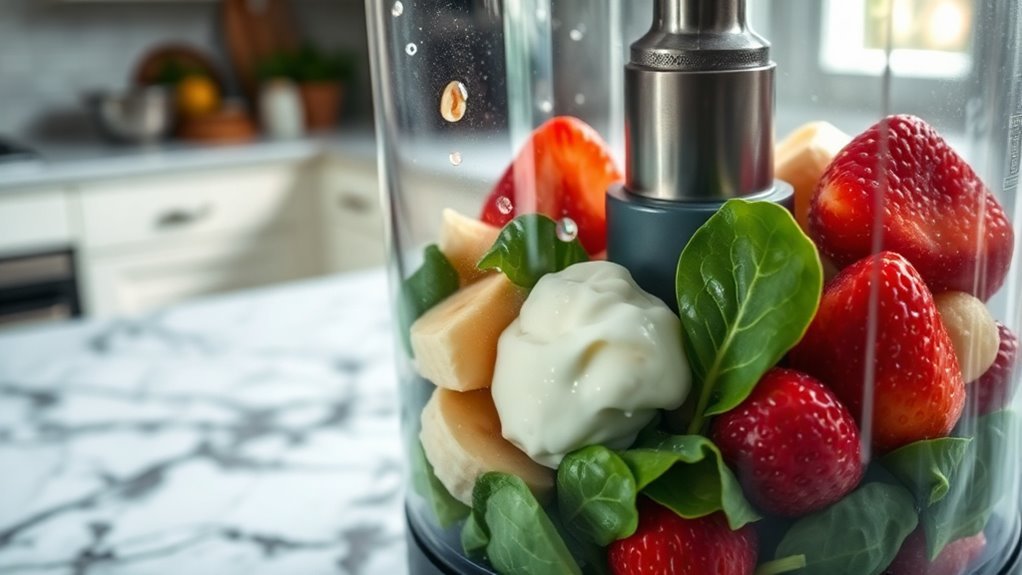
How You Make a Smoothie in a Food Processor
You can make a smoothie in your food processor by starting with ripe, chopped fruits and about 1 cup of liquid to help ingredients circulate.
Use the pulse function in short bursts, scraping the bowl often to avoid overprocessing and overheating.
Frozen fruit should be slightly thawed or cut into smaller pieces to prevent motor strain.
Keep batches small and add greens or nuts gradually for a balanced blend.
For tips on perfecting texture and flavor, keep exploring these techniques.
Is a Food Processor Good for Making Smoothies?
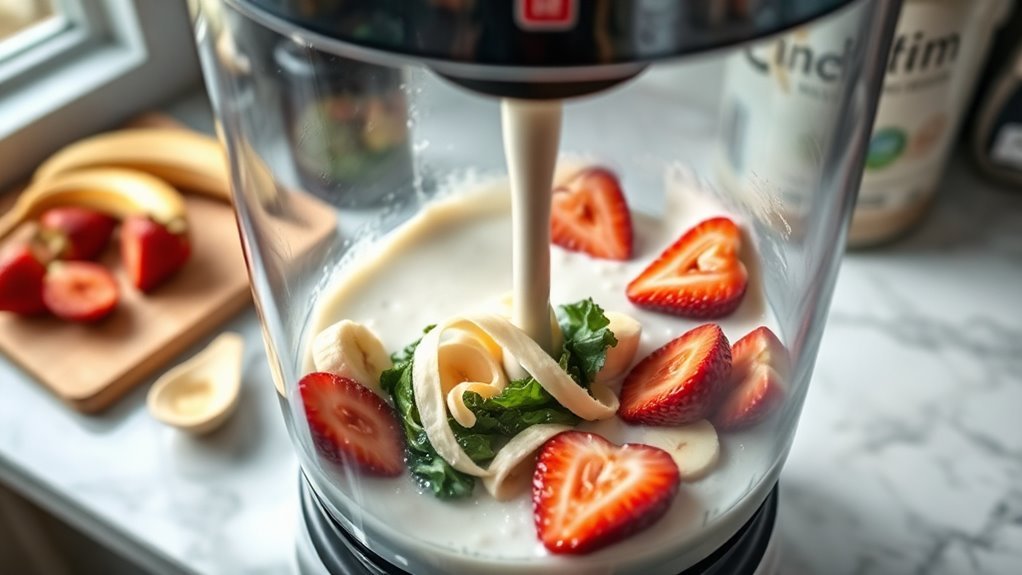
While food processors can make smoothies, you’ll need to add extra liquid and use softer or thawed fruit to help ingredients blend smoothly. Food processors don’t create the strong vortex blenders do, so expect a chunkier or frothier texture. They chop rather than puree, which affects the final consistency.
To get the best results, use the pulse function or blend in short bursts, scraping the bowl often to avoid overprocessing and turning your smoothie into mush. Food processors struggle with ice and large frozen chunks, so break or thaw them before blending, or work in small batches to prevent motor strain.
If you want a thick smoothie bowl or a nut-butter-enriched blend, a food processor can be a great choice. But for pourable, silky smoothies, a high-powered blender usually works better. Overall, food processors are versatile but require some adjustments for smoothies.
Preparing Ingredients for Food Processor Smoothies
Start by picking fresh, ripe fruits and veggies—they’ll give you the best flavor and nutrition. Then, chop any larger pieces into 1 to 2-inch chunks so they blend evenly in your food processor. Make sure to measure your ingredients carefully, too, to keep the texture smooth and consistent every time.
Selecting Fresh Ingredients
Choosing fresh ingredients guarantees your smoothie tastes vibrant and blends smoothly in a food processor. Start with fresh leafy greens like spinach or kale, washing them thoroughly and removing tough stems to make sure even processing. Use about 1/2 to 1 cup packed for balanced texture.
For fruits, peel and chop firm options such as apples, pears, or bananas into roughly 1-inch pieces to help your food processor chop uniformly. Incorporate frozen fruit, like 1 to 1 1/2 cups of frozen berries or sliced bananas frozen on parchment for at least 30 minutes, to add creaminess and reduce the need for ice.
Don’t forget to include a liquid base, such as almond milk or water, to help ingredients move toward the blade and prevent stalling.
Prepping Fruits And Vegetables
After gathering fresh ingredients, you’ll want to prepare them properly to make sure your food processor handles them easily. Start your prep work by cutting firmer fruits like apples, pears, and mangoes into ½ to 1-inch cubes to guarantee even chopping.
Slice bananas and halve stone fruits before freezing them on parchment for at least 30 minutes to avoid large chunks that stall the blades. For dense vegetables such as carrots, beets, and raw zucchini, trim and chop into ¼ to ½-inch pieces. Consider lightly steaming very hard veggies to soften them.
Pack leafy greens like spinach or kale loosely, about ½ to 1 cup, and remove thick stems. Always add about 1 cup of liquid first into the bowl to help everything circulate smoothly during processing. This prep work makes blending efficient and consistent.
Portioning For Consistency
When you portion ingredients carefully, your food processor handles them more efficiently, resulting in a smoother, more consistent blend. Cut fruits into uniform ½ to 1-inch pieces to prevent uneven chopping and maintain a balanced texture.
Freeze bananas or berries in single layers for at least 30 minutes, using no more than 1 to 1½ cups per batch. This keeps the flavor vibrant without overloading the motor.
Add about 1 cup of liquid first to help circulate ingredients and avoid dry pockets that gum up the blades. Pack leafy greens in ½ to 1 cup portions and pulse with liquid before adding fruit, ensuring even incorporation and preventing stringy bits.
Portion nuts or nut butters carefully, processing whole nuts first for a smooth texture and enhanced flavor.
Choosing the Best Liquid Base for Smoothies
When you’re picking a liquid base for your smoothie, try to use about 1 cup. This helps everything blend smoothly without putting too much strain on your food processor. You can go with water or coconut water if you want something light.
Or, if you’re after a bit more creaminess and flavor, almond, rice, or coconut milk are great choices. Just think about how the liquid will pair with your ingredients. For example, coconut milk works really well with tropical fruits. And if you’re blending greens, a splash of lemon juice can really brighten things up.
Liquid Base Options
Although choosing the right liquid base may seem simple, it plays a crucial role in your smoothie’s texture and flavor. Aim for about 1 cup (237 ml) of liquid per batch to keep ingredients circulating smoothly without overflowing or thinning your blend too much.
For the perfect smoothie, pick water or coconut water for a light, low-calorie option. If you want creaminess and added protein or calcium, go for almond, soy, or dairy milk. Coconut milk adds richness and fat, ideal for tropical flavors.
When using frozen fruit, start with ¾ to 1 cup and add more as needed to avoid a soupy texture. You can also experiment with cold-brew coffee, tea, or cold-pressed juice for flavor and energy boosts.
Flavor Pairing Tips
Choosing the right liquid base can elevate your smoothie’s flavor and texture, so think about the fruits and ingredients you’re blending. Pairing your liquid wisely complements the taste and helps nut butters blend smoothly for a creamy finish.
Here are three tips to get it right:
- Use coconut milk or water with tropical fruits like mango and pineapple to enhance sweetness and richness.
- For green smoothies, stick to plain water or mild almond milk to keep the leafy greens’ flavor fresh and let nut butters shine without overpowering.
- When adding protein powders or oats, opt for coffee, tea, or dairy/plant milk to improve texture and balance flavors.
Adjust liquids slightly if using frozen fruit to keep your food processor running smoothly.
Adding Greens and Vegetables to Food Processor Smoothies

Adding greens and vegetables to your smoothie boosts its nutrition without sacrificing flavor or texture. Start with ½ to 1 cup of leafy greens like baby spinach or kale for a balanced taste and easy blending.
For tougher veggies like carrots or zucchini, chop them into ½-inch pieces and pulse 6 to 10 times first to avoid large chunks and protect your food processor’s motor. Always add about 1 cup of liquid before the greens to help create a smooth vortex in the wide work bowl.
For fibrous greens such as mature kale, remove thick stems and pulse in short bursts, scraping down the bowl once to prevent stringy bits. Combining frozen fruit with your greens can enhance creaminess but process in small batches and use the pulse function for a uniform texture.
| Ingredient Type | Prep Tips |
|---|---|
| Leafy Greens | Use ½ to 1 cup; remove thick stems |
| Tough Vegetables | Chop into ½-inch pieces; pulse first |
| Frozen Fruit | Process in small batches; pulse |
Selecting and Preparing Fruits for Smoothies
When you’re picking out fruits for your smoothie, try to grab about 1 to 2 cups of fresh or frozen fruit. That way, you’ll get the perfect balance of flavors and texture.
If the fruit is on the larger side, it’s a good idea to chop it into pieces about half an inch to an inch big. This helps everything blend smoothly without jamming your processor.
And if you’re using frozen fruit, just let it thaw a little bit first. Or you can pulse the blender in short bursts—that way, you keep the smoothie nice and smooth without any icy chunks.
Choosing Fresh Fruits
Fresh, ripe fruits bring natural sweetness and vibrant flavors to your smoothie while ensuring smooth processing in a food processor. To choose the best fruits, keep these tips in mind:
- Pick ripe but firm fruits, like bananas with a few brown spots or peaches that yield slightly to pressure. This enhances flavor without making your smoothie mushy.
- Opt for a balance of sweet (banana, mango) and tart (berries, pineapple) fruits to create a well-rounded flavor profile.
- Rinse delicate fruits like strawberries and blueberries thoroughly, then pat dry to avoid excess water that can thin your smoothie.
Preparing Fruit Portions
Selecting and preparing the right fruit portions sets the foundation for a perfectly blended smoothie. Use 1 to 2 cups of fruit per smoothie, mixing bold flavors like banana or pineapple with milder ones such as strawberries or apples to balance sweetness and acidity.
Slice fresh fruits into ½- to 1-inch pieces so they chop evenly in your food processor’s wide bowl. For creaminess, opt for frozen fruit. Slice bananas and freeze them for at least 30 minutes or use frozen berries or mango chunks.
When working with hard fruits like apples, remove cores and skins, then pulse briefly to protect your motor. Measure fruits in smaller batches, filling no more than two-thirds of the bowl. Add about 1 cup of liquid to help the mixture flow smoothly toward the blades.
Incorporating Healthy Fats Into Smoothies
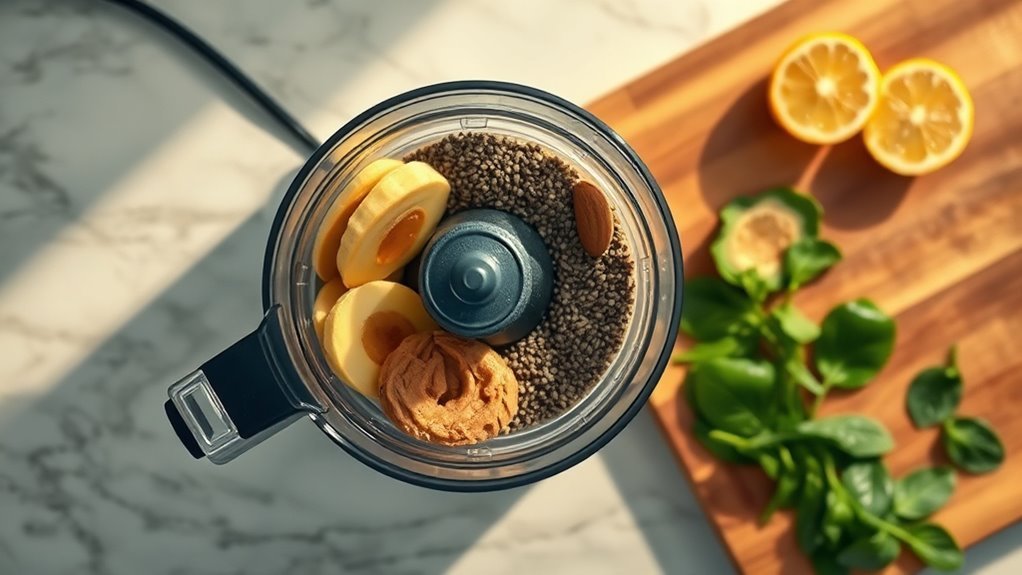
Adding healthy fats to your smoothie not only boosts creaminess but also helps your body absorb fat-soluble vitamins more effectively. When using a food processor, you gain better control over texture, ensuring your smoothie is smooth and enjoyable. Here’s how to incorporate healthy fats smartly:
- Add 1–2 teaspoons of almond butter, flaxseed oil, or avocado to a single-serving smoothie (12–16 oz). These fats enhance creaminess and nutrient absorption without overwhelming flavor or calories.
- Soften hard fats before blending. Slightly thaw frozen bananas or warm coconut oil briefly. Chop nuts finely to help thick mixtures move efficiently toward the blade, maintaining smooth consistency.
- For omega-3 benefits, grind whole flaxseed or chia seeds in the processor first to avoid grittiness and maximize nutrients.
Keep total fat additions modest, about 5–15% of calories, to maintain balance. If the smoothie thickens too much, thin it with a few tablespoons of liquid and pulse again for perfect texture control.
Managing Batches and Scraping for Better Blends
To get the smoothest blends, you’ll want to process your ingredients in small batches, no more than 2 cups of fruit and 1 cup of liquid at a time. This prevents overloading your food processor and helps ingredients circulate properly toward the blades.
As you blend, stop every 20–30 seconds to scrape the bowl and blade with a rubber spatula. This redistributes the mixture, avoids uneven chunks, and eliminates air pockets for a better texture.
If your blend is thick or contains frozen fruit, work in 1-cup increments and allow the motor to rest if it warms up. This could take at least 30 minutes for a full batch. Adding liquids gradually between pulses also improves flow and control over texture.
Getting Smooth Texture With Pulse and Scraping
Frequently pulsing your food processor in short bursts helps you break down frozen fruit and ice without turning the mixture into mush. This method lets you control the texture almost instantly while preserving the integrity of your ingredients.
Pulsing in short bursts prevents mushy blends and lets you control texture while keeping ingredients intact.
To get a smooth texture with pulse and scraping, follow these steps:
- Pulse in 1–2 second bursts to chop frozen fruit and ice into smaller pieces without over-processing.
- Every 15–30 seconds, stop and scrape down the bowl sides with a spatula so unprocessed chunks fall toward the blades for even blending.
- Once you reach a nearly smooth consistency, run the processor continuously on low speed for 5–10 seconds to finish the mixture without overheating or making it too runny.
Using the Pulse Function to Control Texture
Although you might be tempted to run your food processor continuously, using the pulse function gives you greater control over your smoothie’s texture. Start with short, 1 to 2 second pulses to break frozen fruit and ice into coarse pieces. This prevents motor strain and uneven chopping.
Then, pulse in 3 to 5 second bursts while watching the mixture through the wide bowl. Stop to scrape down the sides between pulses to make certain even processing. If you want a chunkier smoothie, pulse 6 to 8 times total, finishing with a low-speed run if available.
For a smoother texture, alternate 4 to 6 pulses with brief continuous runs. When adding thick ingredients like nut butter or banana, pulse 4 to 6 times to distribute them evenly, add about 1/4 cup liquid, and pulse again to help move ingredients toward the blades. Avoid running the processor continuously for more than 20 to 30 seconds; pulsing controls heat buildup and prevents over-processing into a puree.
Adding Boosters Like Herbs, Spices, and Sweeteners
Controlling your smoothie’s texture with the pulse function sets the stage for adding flavor boosters like herbs, spices, and sweeteners. These additions can elevate your smoothie without affecting the desired fat content. Here’s how to do it right:
Using the pulse function perfects texture and allows seamless addition of herbs, spices, and sweeteners without altering fat content.
- Herbs: Add fresh herbs like cilantro or mint near the end of processing, about 1–2 tablespoons chopped, to preserve their bright flavor and avoid bitterness. Use stronger herbs like basil sparingly, around 1 tablespoon, to prevent overpowering.
- Spices: Incorporate ground spices such as cinnamon or turmeric in small amounts, 1/8–1/4 teaspoon. Pulse and taste to avoid clumping and guarantee a balanced flavor.
- Sweeteners: Add liquid sweeteners like honey or agave, 1–2 teaspoons, through the feed tube or with the liquid base for even blending.
If you want to boost flavor with fibrous ingredients like fresh ginger, grate finely, about 1/2 teaspoon, to maintain a smooth texture and keep the processor running smoothly.
Frequently Asked Questions
How Do I Clean My Food Processor After Making a Smoothie?
To clean your food processor after making a smoothie, immediately unplug it and remove the lid and bowl. Scrape out leftovers to avoid staining.
Rinse the blade carefully by its center hub to maintain blade maintenance and prevent dulling. Wash all parts in warm, soapy water or dishwasher if allowed.
For stubborn odors, soak parts in baking soda water or rub with lemon. Dry everything thoroughly, wipe the base with a damp cloth, and store blades safely.
Can I Use a Food Processor for Hot Smoothie Ingredients?
Yes, you can use a food processor for hot smoothie ingredients, but you need safety precautions. Don’t fill the bowl more than two-thirds full, and keep the lid vented or slightly ajar to let steam escape.
Pulse slowly to avoid pressure build-up or splattering. Check your processor’s max temperature limits, and cool very hot ingredients to warm before blending.
After, let everything cool before opening to prevent burns.
What Are Common Food Processor Mistakes When Making Smoothies?
Oh sure, just go ahead and overfill the container like it’s a never-ending party. What could possibly go wrong? You’ll end up with leaks, splashes, and a very angry kitchen.
Besides that, skipping added liquid, tossing in frozen fruit without thawing, and ignoring processing time will leave you with chunky chaos or a stalled motor. Remember, food processors aren’t blenders. Respect the limits, and your smoothie will thank you.
How Long Should I Blend Smoothies in a Food Processor?
You should blend your smoothie in a food processor for about 20–30 seconds on pulse, then run it continuously for another 20–40 seconds to get the perfect texture timing. If using frozen fruit or ice, shorten the continuous runs to 10–20 seconds and pulse 2–3 times to protect the motor.
Remember to stop and scrape the bowl after 30–45 seconds to keep everything evenly mixed and smooth.
Can I Store Smoothie Leftovers Made in a Food Processor?
You can absolutely tuck your smoothie leftovers into the fridge, like saving a splash of sunshine for later. Just keep refrigeration timing in mind. Store them in airtight containers and try to drink within 24 to 48 hours to keep flavors fresh and vibrant.
To slow the browning dance, add a squeeze of lemon juice and fill containers tight. Remember to give your smoothie a good shake before sipping, since separation is natural after a while.
Conclusion
You might think a blender is your only smoothie hero, but a food processor can surprise you with its power and versatility. While blenders excel at silky textures, food processors handle chunky, hearty blends with ease.
By prepping your ingredients right, choosing the best liquids, and mastering the pulse, you’ll create vibrant, nutrient-packed smoothies that satisfy both taste and texture cravings. Give your food processor a chance; it’s more than just a prep tool!