
How Much Does a Food Processor Cost?
You can expect to pay between $20 and $120 for a food processor, depending on size, power, and features.
Smaller, entry-level choppers like the Ninja NJ100 cost around $20 to $40, while midrange models with larger bowls and stronger motors fall between $50 and $70.
High-end processors with professional features usually range from $70 to $90. Deals and seasonal discounts often bring prices down, making it easier to find one that fits your kitchen needs and budget.
Exploring different capacities and brands can help you pick the ideal model for your cooking style.
Typical Price Ranges for Food Processors
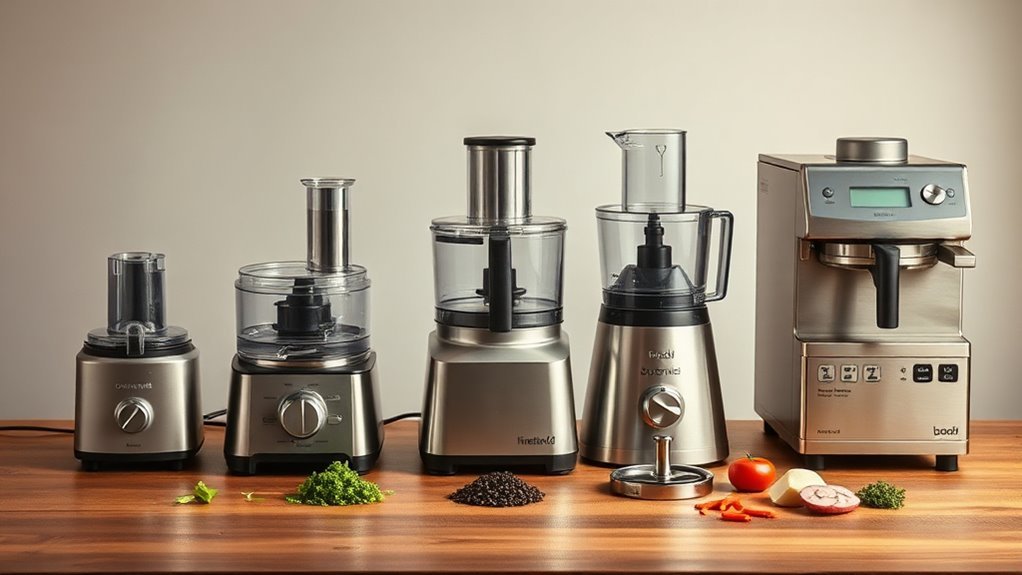
When shopping for a food processor, you’ll find prices vary widely based on size, power, and features. If you’re just starting meal prep, entry-level compact choppers like the Ninja NJ100 offer great value, typically costing between $20 and $40. These small processors are perfect for simple tasks without breaking the bank.
Entry-level compact choppers like the Ninja NJ100 offer affordable, simple solutions for beginners starting meal prep.
Moving up, mid-range full-size food processors usually range from $50 to $100. Options like the BLACK+DECKER 8-cup or 12-cup models priced around $60 give you more capacity and versatility for everyday meal prep.
For more power and multifunctionality, expect to spend $60 to $120 on models with stronger motors and extra accessories, such as the TINANA or RUIE units, especially during sales. Sales can markedly reduce prices, so you can snag premium features without paying full price.
Whether you’re focused on quick meal prep or more complex recipes, there’s a food processor priced just right for your needs.
How Food Processor Capacity Influences Price
You’ll notice that food processors with larger bowls usually come with higher price tags. For example, 12-cup models often cost more than smaller 2–3 cup choppers. So, choosing the right capacity means balancing how much you need with what you’re willing to spend.
Capacity Versus Price
Because larger-capacity food processors handle more ingredients at once, they usually come with a higher price tag. When you choose a bigger model, like a 12-cup unit, you’ll notice its bowl ergonomics are designed for ease during heavy prep, but this often means a larger storage footprint in your kitchen.
You’ll also want to think about serviceability considerations. Bigger processors might have more complex parts, which can affect maintenance costs and ease of repair. Smaller 3 to 8 cup processors are more budget-friendly and fit compact spaces, ideal for quick tasks.
Mid-range multifunction models with 10 to 12 cup capacity typically fall between $59 and $70, reflecting their balance of volume and features. Ultimately, capacity impacts price, but also how the processor fits your space and maintenance needs.
Larger Bowls Cost More
Choosing a larger-capacity food processor usually means paying more upfront. Bigger bowls like 10 to 12 cups boost batch efficiency, letting you prep family-sized meals faster.
They often come with extra features and durable materials, which justifies their higher cost. However, you’ll need more storage space, so consider your kitchen layout before buying.
| Feature | Small (2–3 cups) | Large (10–12 cups) |
|---|---|---|
| Batch Efficiency | Smaller batches, more runs | Large batches, less time |
| Storage Considerations | Compact, easy to store | Requires more space |
| Material Durability | Basic materials | Heavy-duty, long-lasting |
Investing in a larger bowl pays off if you value speed and durability. Just be mindful of storage constraints.
Comparing Basic and Multifunction Food Processors

You’ll find that basic food processors usually cost less and focus on simple chopping tasks. On the other hand, multifunction models come with more attachments and higher power, which means they’re much more versatile.
Capacity is another important factor to consider. Larger units can handle bigger batches, but they often come with a higher price tag.
Price Differences Explained
While basic food processors focus on essential functions like chopping with limited speed and power, multifunction models pack in higher wattage, multiple blades, and larger capacities that justify their higher prices. When deciding, keep in mind:
- Material quality impacts durability and price. Stainless steel blades and sturdy bowls cost more but last longer.
- Regional pricing varies due to taxes and shipping. Prices you see online may differ locally.
- Seasonal trends influence discounts, especially during holidays or sales events. Timing your purchase can save money.
Basic units like the BLACK+DECKER 8-cup run under $50, while multifunctional 10–12 cup models with extra accessories usually range from $59 to $70. Premium combos with blender jars or added features push prices higher but offer versatility that basic models don’t.
Functionality Comparison Overview
Though basic food processors excel at straightforward tasks like chopping and pureeing, multifunction models offer a broader range of capabilities that can streamline your kitchen prep.
While basic units are quieter with simple safety features, multifunction processors may have higher noise levels but include advanced safety locks and more attachments.
Maintenance tips vary: basic models need less frequent blade changes, while multifunction units require careful cleaning of multiple parts.
| Feature | Basic Processor | Multifunction Processor |
|---|---|---|
| Noise Levels | Lower, less powerful | Higher, due to stronger motors |
| Safety Features | Basic locks | Advanced interlocks and sensors |
| Maintenance Tips | Simple cleaning, fewer parts | Regular blade checks, multiple parts |
| Functions | Chop, puree, slice | Shred, knead, blend, juice |
Capacity and Power Variations
Because food processors vary widely in capacity and power, selecting the right model depends on your typical kitchen tasks and batch sizes. Basic processors, like the BLACK+DECKER 8-cup (450W), handle small to medium batches efficiently, while multifunction units, such as the RUIE 12-cup or TINANA 10-cup (1000W), manage larger volumes and tougher tasks with ease.
Consider these factors when choosing:
- Voltage compatibility – make certain the processor fits your home’s power requirements.
- Noise levels. Higher power often means louder operation, so balance performance with comfort.
- Maintenance needs. Multifunction models may require more cleaning due to extra attachments.
Choosing between basic and multifunction processors depends on your prep volume, power needs, and how much upkeep you’re willing to handle.
Why Food Processor Power and Wattage Matter

If you want your food processor to handle everything from light chopping to heavy-duty tasks like kneading dough, choosing the right power and wattage is essential. Higher wattage means more torque, which prevents stalling and guarantees consistent blade speed, supporting motor longevity. However, more power often comes with noise tradeoffs and increased energy use.
Look for models with thermal protection to avoid motor overheating during extended use, especially if you process dense ingredients frequently.
Here’s a quick guide:
| Wattage Range | Suitable Tasks |
|---|---|
| 200-400W | Light chopping, small batches |
| 450-600W | Everyday chopping, pureeing |
| 700-900W | Dough kneading, shredding tough veggies |
| 1000W+ | Heavy-duty, large volumes |
| Consideration | Motor longevity, noise tradeoffs, thermal protection |
Match wattage to your needs to guarantee durability and avoid overspending on unnecessary power.
How Accessories Affect Food Processor Prices
Accessories can substantially influence the price of a food processor, as they add versatility and convenience to your kitchen tasks. When you opt for models with extra attachments like salad spinners or multiple bowls, you’ll typically pay more upfront. However, these additions often enhance accessory longevity, meaning you get more durable tools that last longer. Plus, some brands offer color coordination, helping your processor blend seamlessly into your kitchen décor.
Consider these key points when evaluating accessory impact on cost:
- Multi-function bundles (slicer, shredder, dough mixer) increase price due to added capabilities.
- Combo units with blending or travel jars usually cost more but bring extra convenience.
- Storage solutions included with accessories can justify higher prices by keeping your kitchen organized.
Basic processors with fewer attachments are cheaper but provide less flexibility. Ultimately, investing in versatile, well-designed accessories makes certain your food processor meets diverse needs over time.
How Brand Reputation Impacts Food Processor Costs
You’ll notice that trusted brands often come with higher price tags. That’s because people are usually willing to pay more for reliability and quality. Take premium names like Ninja, for example—they command top dollar thanks to their strong reputations and positive reviews. This reputation doesn’t just affect the initial purchase price; it also boosts resale value and the overall perceived worth of the product.
Brand Trust And Pricing
Because brand reputation directly influences consumer trust, you often pay more for well-known food processor brands like Ninja, which boasts high ratings and reliability. This is a clear example of pricing psychology, where brand perception acts as a trust signal, encouraging buyers to spend more.
Midrange brands like BLACK+DECKER and Hamilton Beach balance cost and trust, while lesser-known brands offer lower prices but less consumer confidence. When choosing, consider how these factors affect pricing:
- Brand perception boosts your confidence in product quality and longevity.
- Trust signals like customer reviews and delivery options justify price differences.
- Pricing psychology leverages reputation to influence what you’re willing to pay.
Understanding these elements helps you pick a food processor that matches your budget and expectations.
Premium Brands Demand
Premium-brand appeal often drives food processor prices higher, reflecting the trust and quality consumers associate with names like Ninja. This brand premiumization results in prestige pricing, where you pay more for perceived reliability and advanced features. Luxury positioning lets these brands command top-dollar prices, unlike value brands that rely on discounts to compete.
| Brand | Price Range | Features | Reviews | Pricing Strategy |
|---|---|---|---|---|
| Ninja | $100+ | High-end, versatile | 6,108 (4.7⭐) | Prestige pricing |
| Hamilton Beach | $60-$90 | Midrange, promotes deals | Moderate | Moderate premium |
| BLACK+DECKER | ~$50 | Basic functions | 1,849 | Competitive pricing |
| TINANA | ~$60 (discount) | Multi-function, budget | Low | Discount-driven |
| RUIE | ~$70 | Extra features, mid-tier | Moderate | Value with features |
You’ll notice premium brands justify higher costs through quality and reputation, shaping your willingness to invest.
Reputation Influences Value
When choosing a food processor, brand reputation plays a key role in determining both cost and perceived value. Established brands like Ninja and BLACK+DECKER often charge more because their strong brand perception boosts consumer trust.
Social proof, such as high review counts and ratings, directly affects how much you’re willing to pay. Lesser-known brands might offer lower prices but lack this advantage.
Here’s how reputation influences value:
- Higher brand perception leads to higher prices and better resale value.
- Social proof from numerous positive reviews justifies premium costs.
- Fast delivery and retail presence enhance convenience, increasing perceived worth.
Using Sales and Promotions to Save on Food Processors
Keep an eye out for marked-down food processors to score significant savings without sacrificing quality. Limited time offers often slash prices on popular models like the RUIE 12-cup, now $69.98 (down from $129.99), or the TINANA 10-cup 1000W at $59.39 (was $106.99).
Watch for deals on top food processors like the RUIE 12-cup and TINANA 10-cup for great savings.
Midrange bargains, such as the Hamilton Beach 3-in-1 for $62.99, also provide solid value. You can maximize your savings by using shipping hacks. Take advantage of fast-shipping promotions or same-day delivery options, like those from BLACK+DECKER and Hamilton Beach, to avoid extra shipping fees and get your processor sooner.
Don’t overlook bundle discounts either. Some retailers offer deals when you purchase accessories or complementary kitchen gadgets alongside your processor. Before buying, compare discounts with customer reviews and capacity to make certain you’re getting a reliable product that suits your needs.
This approach helps you stay within budget while investing in a food processor that offers great performance and durability.
Budget-Friendly Food Processors Under $50
Finding a reliable food processor under $50 doesn’t mean you have to compromise on quality or convenience. These budget-friendly models handle compact recipes effortlessly and fit nicely in your kitchen without hogging countertop storage. They’re perfect if you’re new to food processors and want something simple with beginner maintenance.
Here are three highlights of budget-friendly food processors under $50:
- BLACK+DECKER 8-Cup Food Processor offers 2 speeds plus pulse, with a 450W motor handling chopping and slicing tasks efficiently.
- Ninja Food Chopper 2-Cup NJ100 is compact and highly rated, ideal for small batches and quick prep.
- Many models provide fast delivery or same-day pickup, so you can start cooking right away.
While these units may lack advanced attachments, their smaller size and straightforward features make them excellent for everyday chopping and blending without cluttering your kitchen.
Midrange Food Processors Priced $50 to $70
Explore midrange food processors priced between $50 and $70 to upgrade your kitchen prep with larger capacities and versatile functions. These models, like the RUIE 12-Cup ($69.98) and Hamilton Beach 3-in-1 ($62.99), offer 8 to 12 cups capacity, making ingredient prep faster and easier.
You’ll find multiple functions such as chopping, slicing, shredding, and dough mixing. Noise levels vary but generally remain moderate, balancing power and quiet operation. Durability testing shows these units handle regular use well, especially models with stronger motors like TINANA’s 1000W 10-cup processor.
| Model | Capacity | Key Features |
|---|---|---|
| RUIE 12-Cup | 12 cups | Salad spinner, multi-function |
| Hamilton Beach 3-in-1 | 10 cups | Blender + travel jar combo |
| Black+Decker 8-Cup | 8 cups | Basic 450W, 2-speed + pulse |
These processors combine value and versatility, ideal for elevating your kitchen prep.
High-End and Specialty Food Processors ($70–$90)
When you step into the $70 to $90 range, high-end and specialty food processors offer larger capacities, powerful motors, and versatile functions that can truly enhance your kitchen experience. Here, you’ll find models like the RUIE 12-Cup and Hamilton Beach 3-in-1, which pack up to 1000W motors and multiple attachments for slicing, shredding, and dough mixing.
These processors often focus on user convenience with features like cordless models for easy maneuvering, noise reduction technology for quieter operation, and compact storage designs that save counter space.
Consider these key advantages:
- Larger 10–12 cup capacities to handle bigger batches effortlessly
- Multifunction attachments that add slicing, shredding, and more
- Enhanced usability with noise reduction and cordless options
With solid customer ratings and practical extras, these processors provide excellent value if you want a powerful, versatile kitchen helper without breaking the bank.
Where to Find the Best Deals and Fast Shipping
You can snag excellent deals on food processors without waiting long for delivery. Budget options like the BLACK+DECKER 8-Cup are around $49.87 with free shipping and same-day delivery or local pickup in some areas. Midrange models, such as the Hamilton Beach 3-in-1, drop from $89.99 to $62.99 and include next-day shipping.
Larger units like the RUIE 12-Cup with salad spinner cost $69.98, down from $129.99, with free shipping arriving as soon as tomorrow. High-power multifunction models like the TINANA 10-Cup 1000W are now $59.39, also with next-day delivery.
To make certain a smooth purchase, check return policies carefully. Many retailers offer hassle-free returns if the processor doesn’t meet your needs. Local pickup can be a great way to avoid shipping delays while securing a good deal.
For fast shipping speed and top ratings, the Ninja NJ100 2-Cup chopper is often available for immediate or same-day delivery, letting you start cooking sooner.
Choosing the Right Food Processor for Your Budget
Finding the best deal on a food processor is just the start; choosing one that fits your budget and meets your cooking needs is equally important. To help, consider these key points:
- Functionality vs. Price: Budget-friendly models like the BLACK+DECKER 8-Cup offer basic power and speeds, perfect for everyday chopping. Mid-range or discounted high-power units, such as the TINANA 10-Cup 1000W, provide more versatility without breaking the bank.
- Countertop Storage & Noise Levels: If space is tight, compact models like the Ninja NJ100 save room and often run quieter, making them great for small kitchens or noise-sensitive environments.
- Maintenance Tips: Choose food processors with easy-to-clean parts to save time and effort. Models with dishwasher-safe components reduce hassle and keep your appliance lasting longer.
Balancing these factors makes certain you get the right food processor that fits your budget, kitchen space, and lifestyle.
Frequently Asked Questions
How Do Food Processors Differ From Blenders?
Food processors differ from blenders mainly in blade variety, container capacity, and motor speed. You’ll find food processors have multiple interchangeable blades for chopping, slicing, and kneading, while blenders use fixed blades for pureeing.
Their containers are wider and larger to handle chunky batches, unlike blenders’ tall pitchers designed for liquids. Also, food processors usually have motors focused on torque for tough tasks, whereas blenders prioritize high motor speed to create smooth textures.
What Maintenance Is Required for Food Processors?
Think of your food processor as a hardworking chef. It needs care to keep performing well. You’ll want to sharpen blades regularly to slice through ingredients like a hot knife through butter.
Keep the motor cool by wiping vents and avoiding moisture buildup. Store parts with covers to protect blades and prevent accidents. Clean removable components after each use, and check seals and screws to avoid slipping or leaks.
This care keeps your machine humming smoothly.
Are Food Processors Dishwasher Safe?
Yes, many food processors are dishwasher safe, but you’ll want to check the manufacturer’s label for dishwasher durability. Usually, plastic bowls and lids go on the top rack to avoid warping, while metal blades often need hand washing to keep them sharp longer, despite being dishwasher-compatible.
Also, use detergent compatible with your machine’s materials to prevent damage. Always avoid submerging the motor base and follow care instructions closely for best results.
Can Food Processors Be Used for Dough Kneading?
Yes, you can use food processors for dough kneading, especially models with a dough blade and at least 8 to 12 cup capacity. You’ll want to monitor dough hydration carefully, as processors mix quickly and can make dough too wet or dry.
Remember to keep resting times in mind to allow gluten development after kneading. Pulse in short bursts to avoid overheating the motor, ensuring your dough gets the proper texture and elasticity.
How Noisy Are Typical Food Processors During Operation?
If you’ve ever used the Ninja Food Chopper NJ100, you’d notice its noise levels are quite low, around 70 decibels, thanks to minimal motor vibration.
Typical food processors usually produce noise levels between 70 and 90 decibels, similar to busy traffic or a vacuum cleaner. Higher motor wattage often means louder operation, so decibel ratings can spike during heavy tasks.
Checking reviews helps you gauge real-world noise before buying.
Conclusion
When it comes to food processors, you don’t have to break the bank or sell a kidney to find the perfect one. Whether you want a simple slicer or a powerhouse with every gadget imaginable, there’s something out there that fits your budget and kitchen dreams.
Don’t stress over tiny price differences; even a midrange model can feel like a culinary wizard in your hands. So go ahead, grab one—you’re about to become a food prep superhero!