How Does a Food Processor Work?
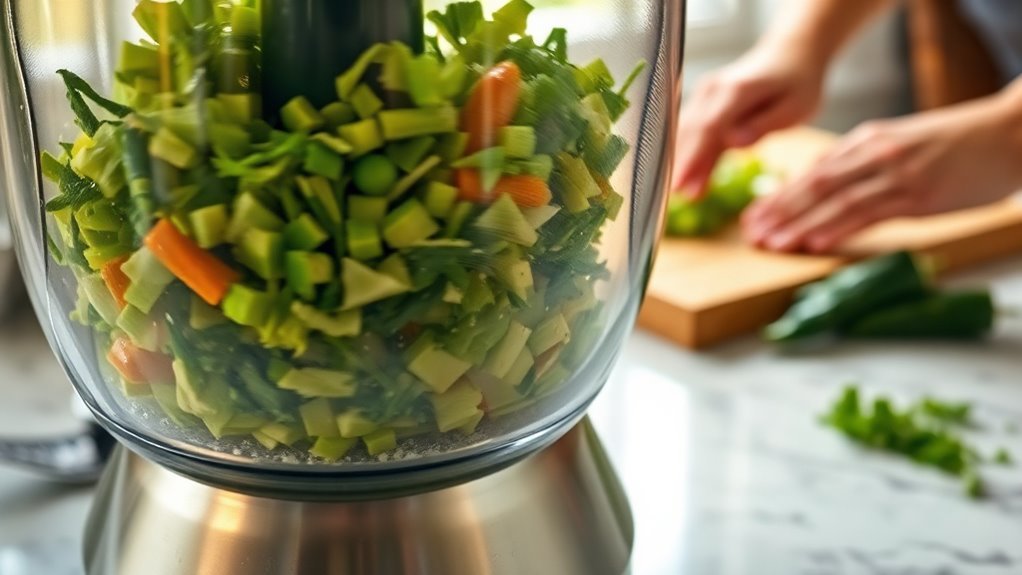
A food processor works by spinning sharp stainless-steel blades inside a sealed bowl, chopping, slicing, shredding, or pureeing your ingredients quickly and safely.
You control it using various speeds and a pulse function, which gives short bursts of power for better texture control.
Using the feed tube, you add ingredients steadily, preventing overprocessing or motor strain.
Choosing the right blade and bowl size enhances performance.
Keep going to discover how to maximize your food processor’s potential and troubleshoot common issues.
How Food Processors Work
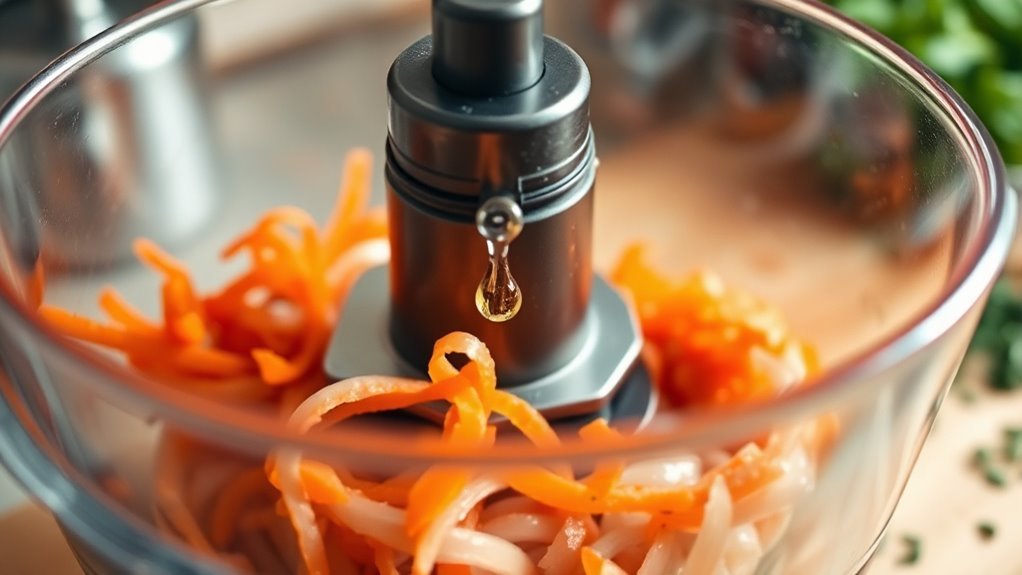
A food processor works by spinning stainless-steel blades or discs inside a sealed bowl, powered by a motor-driven central spindle. When you load ingredients into the work bowl through the feed tube, the motor sets the blades and discs in motion, chopping, slicing, shredding, or pureeing as needed.
A food processor uses motor-powered blades spinning inside a sealed bowl to chop, slice, shred, or puree ingredients.
You’ll find that different blades and discs handle specific tasks. Multipurpose blades chop and puree, while reversible discs slice or shred efficiently. The feed tube plays a vital role by guiding food safely into the spinning blades.
Some models feature wide or multi-functional feed tubes, allowing you to add larger chunks or whole vegetables without stopping. You can control the processing speed, using Pulse for short bursts to avoid overprocessing or continuous speeds for thorough blending.
This setup lets you tackle everything from quick chopped veggies to dough kneading with ease, making food prep faster and more consistent.
Essential Parts of a Food Processor
You’ll find that a food processor’s key components work together to make food prep easier. The motor base powers the blades. Meanwhile, the work bowl holds your ingredients securely during processing.
Getting to know the design of the blades and bowl really helps you use your processor more efficiently and safely. Once you understand how these parts fit and function, the whole process becomes much smoother.
Key Components Overview
Although food processors come in various models, their essential parts work together to make food prep effortless and efficient. The heart of your food processor is the motor base, which powers the rotating multi-purpose blade through a central drive shaft.
This blade, typically made of stainless steel, handles chopping, pureeing, and grinding tasks. Attached securely to the base is the work bowl, available in sizes from about 3.5 to 13 cups, which channels ingredients to the blade while providing a convenient container for processing and cleanup.
A locking lid with a feed tube lets you add ingredients safely during operation. Safety interlocks guarantee the motor runs only when the bowl and lid are properly secured, keeping your food processor both effective and safe.
Blade And Bowl Design
The work bowl and blade form the core of your food processor’s functionality, working together to handle every chopping, slicing, and mixing task efficiently. The work bowl is a sealed, BPA-free container that locks securely to the motor base, creating a stable chamber for processing food without leaks.
The stainless-steel blades spin rapidly on a central drive post, determining texture and cut with their shape and height. To make your life easier, food processors also include interchangeable discs and a smart feed tube. Here’s what you need to know:
- The bowl size ranges from 3.5 to 13 cups, matching your food prep needs.
- Multi-purpose blades and four-blade designs handle chopping, pureeing, and kneading.
- Reversible slicing and shredding discs create uniform cuts quickly.
These features combine to make your food prep faster and safer.
Using Attachments to Expand Food Prep
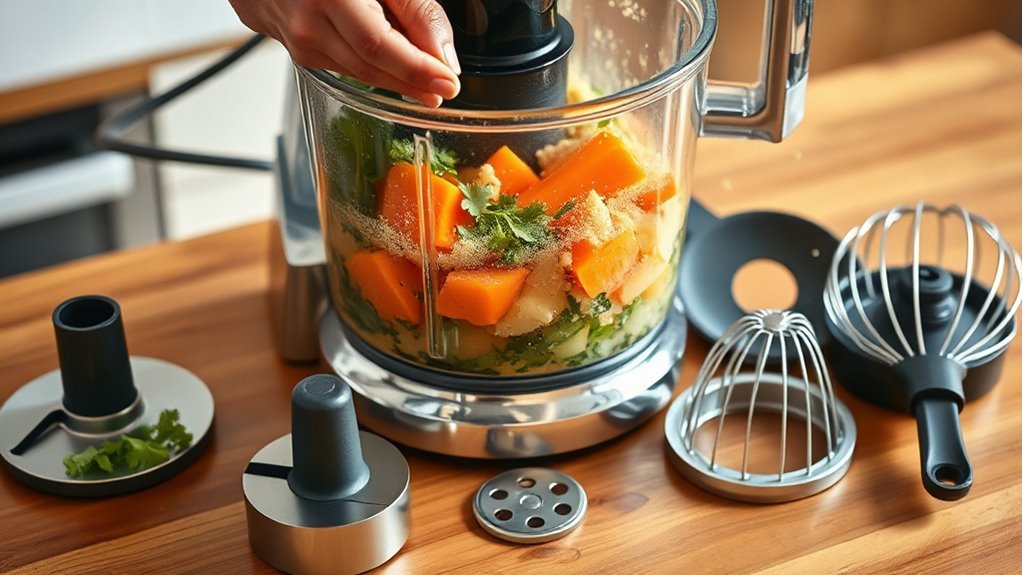
Food processors open up a world of possibilities by letting you swap out attachments tailored to different tasks. Thanks to attachment compatibility, you can switch easily between multi-purpose S-shaped blades, reversible slicing and shredding discs, dough blades, and whisk attachments.
This versatility lets you chop, slice, shred, knead, and even whip without needing multiple appliances. Feed-tube innovations, like 3-in-1 chutes and oil-drizzle openings, enable you to handle long ingredients, adjust slice thickness, and emulsify sauces while adding liquids seamlessly.
These features make prep faster and more precise. Plus, smart storage solutions keep your blades, discs, and lids organized and protected, whether nested inside the bowl or housed in dedicated caddies. This not only prevents damage but also speeds up cleanup, helping you stay efficient in the kitchen.
Feeding Food Safely Through the Processor Chute
When feeding ingredients through the processor chute, always use the feed tube and pusher to guide them safely toward the spinning blade. Never use your hands. Proper pusher etiquette means keeping the pusher firmly in place while the motor runs to avoid accidents.
Always use the feed tube and pusher to safely guide ingredients—never your hands.
To guarantee smooth processing and prevent jams, follow these key tips:
- Chunk sizing matters: cut large or long items like carrots or peppers into pieces that fit easily down the feed tube for even slicing and shredding.
- Feed vertically and slowly to achieve uniform thin slices or shreds using the reversible disc.
- Master the drizzle technique by using the small pusher’s drizzle opening to slowly add oils or liquids during emulsions, guaranteeing a stable blend.
Avoid overfilling the bowl and process bulky loads in batches using the pulse setting for consistent results. These steps keep your prep safe and efficient every time.
How the Pulse Function Improves Control

You’ll find the Pulse function gives you precise control by running the motor in quick bursts. That way, you can stop and check the texture as you go. It really helps prevent overprocessing delicate ingredients like herbs or nuts. By pulsing, you get exactly the chop size you want without turning everything into a puree.
Enhanced Chopping Precision
Although chopping ingredients quickly can be tempting, the pulse function gives you precise control by delivering short bursts of power. This lets you stop and check texture between cuts. This method enhances chopping precision by optimizing texture control and ingredient sequencing.
You can tailor each pulse to your desired consistency, making sure delicate ingredients don’t become mushy. Here’s how to maximize precision:
- Use burst timing of 0.5–2 seconds to avoid over-processing and maintain flavor.
- Feed ingredients intermittently, letting larger pieces settle for uniform chopping.
- Sequence ingredients by size and hardness to prevent uneven cuts or splintering.
Preventing Overprocessing
Because the pulse function runs the motor in short bursts, it gives you precise control to prevent overprocessing and achieve the texture you want. By using pulse, you can practice texture monitoring, adjusting the number of pulses and batch timing to avoid turning coarse chops into puree.
Ingredient sequencing also matters; tougher items need more pulses but careful scraping after every 6 to 8 pulses keeps results uniform. Rotating the bowl or tapping the sides redistributes pieces for even chopping without overheating.
| Task | Pulse Duration | Recommended Pulses |
|---|---|---|
| Coarse chopping | 1–2 seconds | 6–12 |
| Dough & butter mix | Short bursts | Few powerful |
| Onions breakdown | Brief pulses | Moderate |
| Herbs & nuts | Short bursts | Minimal |
Food Processor Safety Features You Should Know
When you use a food processor, safety features work behind the scenes to protect you from accidents. These features help keep you safe while making food prep easier.
Here are three key safety features you should know:
- Childproof locks: Most models include an interlock system that won’t let the motor run unless the bowl and lid are securely locked. This prevents accidental blade engagement, keeping curious hands safe.
- Noise reduction: Some processors come with noise-reducing technology, making operation quieter and less startling. This helps maintain a calm kitchen environment.
- Blade storage: Higher-end processors offer safe blade storage inside the bowl or a dedicated caddy. This keeps sharp parts out of reach and avoids accidental cuts when not in use.
Additionally, many models feature feed-tube pushers to keep your hands away from blades and automatic shut-offs to prevent motor overheating. Always unplug before removing blades for maximum safety.
Food Processor Mistakes to Avoid
Watch out for common mistakes that can damage your food processor or ruin your prep results. One major pitfall is overloading risks. Never fill the work bowl beyond the recommended 7–9 cups for mid-sized models. Overfilling strains the motor and leads to uneven chopping.
Avoid overloading your food processor—stick to 7–9 cups to prevent motor strain and uneven chopping.
Proper ingredient prepping is essential. Always cut large vegetables into smaller chunks before feeding them in. This prevents motor stress and guarantees consistent results.
Mistimed pulsing is another frequent error. Use the pulse function in controlled bursts for items like nuts, herbs, and chunky salsas to avoid turning them into unwanted purees.
Avoid running your processor continuously for long periods. Instead, follow duty-cycle guidelines with short bursts and rests to prevent overheating.
Also, never process hot liquids in the food processor bowl as this can cause pressure build-up and splatter. Use a blender for soups and smoothies instead.
Stick to these tips to keep your food processor working efficiently and your dishes perfect.
Tips for Easy Cleaning and Maintenance
To keep your food processor running smoothly, always unplug it and remove the work bowl before disassembling blades, discs, and lids. This prevents accidental starts and keeps you safe. For easy cleaning and maintenance, follow these tips:
- Blade storage: Store sharp blades and discs inside the bowl or in the provided caddy. This protects your hands and prevents rust by keeping them dry.
- Seal inspection: Regularly check seals and gaskets for cracks or wear. Clean and dry them thoroughly before reassembly to avoid motor damage and mold growth.
- Vent cleaning: Wipe the motor base with a damp cloth to remove dust and food particles. Never submerge the base. Make sure vents are clear to prevent overheating.
Wash removable parts on the dishwasher’s top rack or hand-wash with warm soapy water, using a brush for crevices. These steps keep your food processor efficient and safe for years.
What You Need to Know About Motor Power
Understanding motor power is key to choosing a food processor that handles your kitchen tasks efficiently. Motor power, measured in watts, impacts torque and durability. This is essential when processing dense ingredients or large batches.
Higher wattage means more torque and less risk of stalling or overheating. For cordless models, battery runtime and motor efficiency define how much work you can do on a single charge. Also, look for motor durability features like a solid base and thermal protection to ensure long-lasting performance.
Here’s a quick torque comparison and motor overview:
| Motor Power (W) | Ideal Use | Key Features |
|---|---|---|
| 250 | Mini choppers | Lightweight, limited torque |
| 400-600 | Everyday chopping | Balanced power, quieter |
| 625+ | Heavy-duty processing | High torque, durable motor |
Choosing the right motor power makes certain your processor meets your cooking demands without compromising motor durability or battery runtime.
How to Choose the Right Food Processor Size
Choosing the right food processor size really comes down to matching the bowl capacity with what you usually need in the kitchen. If you’re cooking just for one or two people, a smaller bowl—something around 3.5 to 5 cups—will probably do the trick. But if you’re feeding a family, you’ll want to look at bigger models, like those with 7 to 11 cup capacities.
Also, don’t forget to think about how much dough you might want to make and what accessories come with the processor. These little details can make a big difference when it comes to convenience and how well the machine performs overall.
Matching Bowl Size
Match your food processor’s bowl size to the amount you typically prep to get the best results. Choosing the right size helps with batch scaling, storage considerations, and meal prepping efficiency.
Here’s a quick guide:
- Mini (3.5–5 cups): Perfect for small tasks like salsas or baby food. It’s ideal if you prep single servings or have limited storage space.
- Mid-size (7–9 cups): Great for everyday family meals. It balances capacity and ease of use for sauces, chopping, and purees.
- Large (13–14+ cups): Best for big batches, dough, or entertaining. It offers more attachments but requires more storage.
Consider dough capacity separately since it can be less than the bowl volume. Match your processor to your prep needs for smoother cooking.
Capacity Based Needs
When picking a food processor, you’ll want to base the capacity on the batch sizes you usually prepare. For single servings or small tasks like chopping herbs and making salsas, a 3.5–5 cup mini processor works well and saves countertop storage space.
If you cook for a family or prep meals regularly, a 7–9 cup model suits most needs, balancing batch scaling without multiple rounds. For larger batches, like dough or big shredding jobs, a 10–14 cup processor handles volume easily.
Many mid-to-large models offer internal accessory storage and refrigerator lids, letting you store food directly in the bowl, which optimizes countertop storage. If you’re unsure, starting small with a mini chopper is smart; you can always upgrade as your batch scaling demands grow.
Everyday Recipes to Try With Your Food Processor
You’ll often find that a food processor can speed up many kitchen tasks, from chopping herbs to making dough. It’s perfect for whipping up everyday recipes that save time and elevate your meals. Here are three ideas to get you started:
- Leftover transformations: Use a 3.5-cup mini processor to chop herbs or blend small portions of cooked veggies into flavorful spreads or dips, turning leftovers into something fresh and tasty.
- Quick dressings: Pulse garlic, herbs, and nuts in a medium processor, then drizzle in oil through the feed tube to create smooth, emulsified dressings that brighten salads in seconds.
- Sauce variations: Make pesto or tomato sauces in larger models by pulsing ingredients to your preferred texture. They’re perfect for pasta, sandwiches, or dipping.
With these recipes, your food processor becomes an essential tool for quick, delicious meals every day.
Troubleshooting Common Food Processor Issues
Although food processors simplify many kitchen tasks, they can occasionally run into issues that slow you down. If the motor won’t start, check that the bowl and lid are fully latched. The safety interlock might need a motor reset.
Overheating or strange noises call for noise diagnosis. Pause and let the motor cool 15–30 minutes, especially if you’re processing dense foods.
Uneven chopping usually means overfilling or not prepping ingredients properly. So follow your model’s capacity and use pulse mode.
Leaks often come from poor sealing. Inspect seals and gaskets for damage and apply sealing solutions by ensuring correct assembly.
| Problem | Cause | Fix |
|---|---|---|
| Motor won’t start | Lid not latched | Motor reset, check assembly |
| Overheating | Overload | Cool down, reduce batch size |
| Uneven chopping | Overfilled bowl | Follow capacity, use pulse |
| Dull blades | Worn edges | Replace blades |
| Leaks | Damaged seal or bowl crack | Replace seals, reseat bowl |
Frequently Asked Questions
Can a Food Processor Replace a Blender?
Think of your kitchen as a symphony where each appliance plays its part. A food processor can’t fully replace a blender because it excels in ingredient prep and texture control for chopping, shredding, and dough work, but struggles with silky, liquid-centric blends.
When you compare appliances, you’ll find processors handle chunky sauces and coarse purees well, but blenders outperform in creating smooth, emulsified textures. So, choose based on your primary culinary needs.
Are Food Processors Suitable for Kneading Dough?
Yes, food processors are suitable for kneading dough, especially if you use a mid-to-large bowl and a dough blade. They help mix dough hydration evenly and develop gluten quickly with short pulses or low-speed settings.
Just remember to apply resting tricks. Pause between cycles to prevent overheating and allow the gluten to relax. This way, you get consistent dough without overworking it, saving time and effort compared to hand kneading.
How Noisy Is a Typical Food Processor During Operation?
A typical food processor’s motor noise can roar like a busy city street, reaching 80–95 decibel levels. You’ll notice louder sounds when tackling tough ingredients or using higher wattage motors.
To keep things quieter, sound dampening methods like placing the processor on a mat, using pulse mode, or choosing models with heavy bases help a lot. Securing the lid tightly also cuts down on rattling and extra noise during operation.
Can a Food Processor Handle Frozen Foods?
Yes, your food processor can handle frozen foods, but you need safety precautions and proper thawing methods. Always cut frozen items into small chunks or let them thaw slightly to avoid stressing the motor.
Use short pulses to prevent overheating, and don’t run the blades continuously. Keep up with blade maintenance by sharpening or replacing dull blades, ensuring smooth operation and safety while processing frozen ingredients efficiently.
What Are the Best Brands for Durable Food Processors?
You might think all food processors wear out quickly, but the best brands prove otherwise. Cuisinart and Breville lead in durability thanks to heavy-duty motors and metal drive couplings, ensuring longevity.
KitchenAid offers reliable, everyday-use models, while Hamilton Beach surprises with budget-friendly toughness. For maintenance tips, always clean blades promptly and check replaceable parts regularly.
Comparing longevity, focus on motor wattage and warranties to get the most durable processor for your kitchen.
Conclusion
Now that you know how a food processor works and its key features, isn’t it time to make your kitchen tasks easier? With the right size, attachments, and motor power, you can tackle everything from chopping to pureeing effortlessly.
Using the pulse function gives you perfect control, and feeding food safely keeps things running smoothly. So why wait? Start experimenting with your food processor and enjoy quick, delicious meals every day!