How to Understand Corn Nutrition With a Deep Dive
To understand corn nutrition deeply, focus on key nutrients like nitrogen, phosphorus, and potassium. Each moves differently inside the plant and shows unique deficiency signs.
Learn how corn roots absorb nutrients influenced by soil pH and growth stages. Nitrogen is especially essential during mid-growth and grain fill.
Managing fertilizer timing, placement, and type helps maximize uptake and yield while reducing environmental impact. Keep exploring to uncover how nutrient demand shifts and proper management boosts healthy corn development.
Essential Nutrients Corn Needs To Grow Strong

Although corn needs a variety of nutrients to thrive, nitrogen, phosphorus, and potassium play the biggest roles in its growth. These essential nutrients support your corn at different growth stages, ensuring strong development from seedling to maturity.
Nitrogen uptake is particularly critical because it makes up the largest portion of the plant’s dry tissue, fueling leaf and stalk growth. Phosphorus management is equally important, especially during early growth, since phosphorus influences root development and energy transfer within the plant.
Potassium helps regulate water use and enzyme activation, contributing to overall plant health. Understanding nutrient mobility is key, as mobile nutrients like nitrogen and potassium will move to newer tissues, causing deficiency symptoms to first appear in older leaves.
Corn Root Nutrient Absorption And Uptake
When you examine how corn roots absorb nutrients, you’ll find they mainly take them up in ionic forms, except for boron, which enters as uncharged boric acid. Nutrient absorption happens through root uptake mechanisms like interception, mass flow, and diffusion. Mass flow is especially vital for mobile nutrients.
Your corn’s root size and nutrient concentration at the root surface directly affect uptake efficiency. Mobile nutrients like nitrogen and potassium often show deficiency symptoms first in older leaves, signaling a need for timely intervention.
| Nutrient Type | Uptake Form | Deficiency Symptoms Location |
|---|---|---|
| Nitrogen (N) | Ionic (NO3-, NH4+) | Older leaves |
| Potassium (K) | Ionic (K+) | Older leaves |
| Boron (B) | Boric acid (H3BO3) | Growing points |
| Phosphorus (P) | Ionic (H2PO4-) | Younger leaves |
| Calcium (Ca) | Ionic (Ca2+) | Younger leaves |
Understanding these helps you manage corn nutrition effectively.
How Nutrients Travel Inside Corn Plants
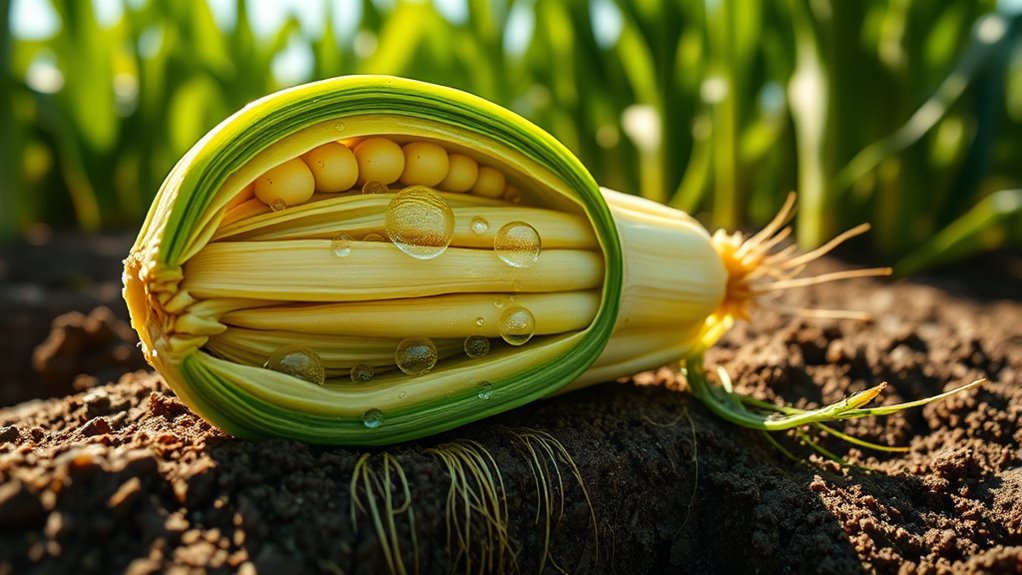
Now that you know how corn roots absorb nutrients, let’s take a look at how those nutrients move inside the plant. They travel through the vascular system, mostly using the xylem and phloem. These tissues carry nutrients to growing parts of the plant in different ways.
Knowing how this movement works can help you recognize deficiency symptoms and manage the plant’s nutrition more effectively. It’s pretty interesting once you see how everything connects!
Nutrient Uptake Mechanisms
Because corn roots absorb nutrients primarily in ionic forms like nitrate and phosphate, understanding how these nutrients move through the soil and inside the plant is key to managing healthy growth.
Nutrient uptake happens as roots absorb ions from the soil solution, where nutrients reach roots through interception, mass flow driven by transpiration, and diffusion. Transpiration pulls water carrying ionic nutrients toward the roots, enhancing root absorption.
Nutrient mobility in the soil affects how easily these ions reach the roots. Mobile nutrients like nitrate move readily with water, while less mobile ones rely more on diffusion.
Internal Nutrient Movement
How exactly do nutrients travel inside corn plants to support growth and development? Internal nutrient movement happens mainly through the xylem and phloem, moving nutrients from the roots to shoots and grains.
Nutrient mobility plays a key role here. Mobile nutrients like nitrogen and potassium can be remobilized from older tissues to new growth, especially during critical plant growth stages.
Immobile nutrients such as phosphorus and calcium stay put, which often causes deficiency symptoms in younger tissues first. Because of this, deficiency symptoms for mobile nutrients usually show up in older leaves, while immobile nutrient deficiencies appear in newer leaves.
Understanding how nutrient mobility and remobilization work helps you better predict when and where deficiency symptoms will occur. This gives you a clearer picture of corn’s nutritional needs throughout its development.
Why Soil PH Matters For Corn Nutrient Availability
Soil pH plays a crucial role in determining which nutrients your corn can absorb effectively. It measures the soil’s acidity or alkalinity, and even a single pH unit change means a tenfold difference in hydrogen ion concentration.
Soil pH is key to nutrient absorption, with each pH unit shift drastically changing acidity levels.
For ideal nutrient availability, aim to maintain soil pH between 6.5 and 7.5. Within this range, your corn can access both essential macronutrients like nitrogen, phosphorus, sulfur, calcium, and magnesium, as well as critical micronutrients such as iron, manganese, boron, copper, and zinc.
When soil pH rises above 7.0, the availability of these micronutrients drops considerably, limiting your corn’s nutrient uptake. Conversely, if the pH falls below 7.0, macronutrient availability diminishes, which can stunt corn growth.
Keeping soil pH within the perfect range prevents nutrient deficiencies and guarantees your corn plants get the balanced nutrition they need for healthy development.
Identifying Corn Nutrient Deficiency Symptoms Early

You’ll often notice mobile nutrient deficiencies, like nitrogen, showing up as yellowing in the older leaves first. On the other hand, keep an eye on the newer leaves for signs of immobile nutrient problems—things like curling or discoloration. Catching these visual symptoms early really helps you step in before your corn’s growth takes a hit.
Recognizing Mobile Nutrient Deficiencies
When do you notice the first signs of nutrient stress in your corn plants? Mobile nutrients like nitrogen and potassium often reveal deficiency symptoms early in the lower leaves.
You’ll see nitrogen deficiency as a general yellowing starting from older leaves, along with slowed growth. Potassium deficiency usually shows up as marginal leaf scorch and necrosis in those same older leaves.
These symptoms occur because mobile nutrients move from older to younger tissues, so the leaf tissue in lower leaves reflects shortages first. Watching for changes in leaf color and tissue health in the bottom leaves helps you catch problems before they spread.
Symptoms in Older Leaves
Although nutrient deficiencies can affect various parts of the corn plant, symptoms in older leaves often provide the earliest clues to mobile nutrient shortages like nitrogen and potassium. Because of nutrient mobility, the plant moves these nutrients from older leaves to support new growth, making symptom recognition in these leaves vital.
Nitrogen deficiency typically shows as chlorosis, or yellowing, in the lower older leaves. Potassium deficiency, on the other hand, causes browning or necrosis along the margins of these older leaves.
Visual Signs of Immobile Nutrients
Since immobile nutrients like phosphorus and calcium can’t move from older leaves, you’ll notice deficiency symptoms first in the newest growth. The limited nutrient mobility means that visual signs appear in new leaves, not the older ones. You’ll often see yellowing, purpling, or necrosis in these areas, signaling a deficiency.
Here are four key visual signs to watch for:
- Yellowing or interveinal chlorosis on new leaves.
- Stunted growth or malformed new leaves.
- Necrosis or dead spots developing on young leaf tissue.
- Purpling of leaves, especially with phosphorus deficiency.
Corn Nutrient Uptake During Growth Stages
As corn develops, it actively absorbs essential nutrients like nitrogen, potassium, magnesium, manganese, and iron, especially during the pivotal vegetative stages between V10 and V14. During these growth stages, nutrient uptake peaks, with nitrogen reaching its maximum demand in mid-vegetative phase and continuing through grain fill.
While phosphorus, sulfur, zinc, and copper accumulate steadily throughout the entire growth cycle, nitrogen and potassium play a key role during reproductive stages. At this time, nutrient partitioning becomes vital as the plant transfers up to 50 pounds of nitrogen into developing seeds.
You’ll notice nutrient movement intensifies during kernel filling, directly influencing yield quality. Understanding how corn shifts nutrient demand between vegetative and reproductive phases helps you manage nutrition more effectively.
Managing Phosphorus And Potassium For Healthy Corn
When you manage phosphorus and potassium effectively, you guarantee your corn plants get the nutrients they need during critical growth stages, especially early development and kernel filling. Phosphorus and potassium uptake peaks during kernel filling, so timely nutrient management is crucial. Both elements are immobile in soil, so applying fertilizer in bands close to the seed enhances early uptake and supports robust growth.
To optimize soil fertility and ensure proper phosphorus and potassium supply, consider these key points:
- Maintain soil pH between 6.0 and 6.5 to maximize phosphorus availability and reduce fixation.
- Use banding fertilizer placement about 2 inches to the side and below the seed for better nutrient access.
- Adjust fertilizer rates to replace nutrient removal, about 65-75 lb P2O5 and 45-55 lb K2O per 200 bushels harvested.
- Regularly test soil to monitor phosphorus and potassium levels, preventing nutrient depletion and ensuring balanced soil fertility.
Best Nitrogen Fertilizer Practices For Corn
How can you maximize nitrogen use efficiency in your corn crop? Start by applying nitrogen in split applications, especially 4-6 weeks after planting. This approach reduces total nitrogen loss and boosts uptake.
Use nitrogen inhibitors to delay the conversion of ammonium to nitrate. This helps cut down on leaching and denitrification, especially in well-drained soils.
When applying urea, incorporate it into the soil promptly to minimize volatilization losses instead of leaving it on the surface. Stick to ideal fertilizer rates, aiming for about 1.0-1.1 pounds of nitrogen per bushel of expected yield. Keep in mind that only 33-66% of applied nitrogen is typically recovered.
Avoid fall nitrogen applications unless soil temperatures stay below 50°F to reduce the risk of nitrogen loss through volatilization and leaching. By following these best nitrogen fertilizer practices, you’ll improve nitrogen efficiency and support a healthier, more productive corn crop.
The 4Rs For Optimizing Corn Nutrient Management
Although managing corn nutrients can be complex, focusing on the 4Rs: Right rate, source, time, and place helps you optimize nutrient use efficiency while protecting the environment. Proper nutrient management means matching nitrogen application to your crop’s needs to maximize crop uptake and minimize losses.
Here’s how to apply the 4Rs effectively:
- Right rate: Apply nitrogen at rates that meet crop demand, especially during the V10 to V14 growth stages, to reduce leaching and runoff.
- Right source: Choose fertilizers like urea or ammonium nitrate, and consider inhibitors to delay nitrate formation, which improves nutrient retention.
- Right time: Time nitrogen application with split applications or delay until 4 to 6 weeks after planting to decrease nitrogen loss and boost yield.
- Right place: Place fertilizer 2 inches beside and below the seed to enhance nutrient uptake without harming seedlings.
Frequently Asked Questions
How Does Corn Nutrition Impact Pest Resistance and Disease Management?
You’ll find that nutrient fortification boosts your corn’s genetic resistance, making it naturally tougher against pests and diseases. Proper nutrition acts as pest deterrents and disease suppressants by strengthening plant defenses.
When you maintain balanced fertilization, your plants resist invasions better, reducing chemical needs. Combine this with diligent pest monitoring to catch issues early, and you’ll manage threats effectively while promoting healthier, more resilient corn throughout the growing season.
What Role Do Microorganisms Play in Corn Nutrient Availability?
Microorganisms play a vital role in corn nutrient availability through microbial symbiosis and nutrient cycling. They help break down organic matter, releasing nutrients steadily for your corn to absorb.
The soil microbiome’s microbial diversity guarantees efficient nutrient transformations, especially nitrogen and phosphorus. By supporting these microbes, you boost nutrient uptake and improve soil health, ultimately enhancing your corn’s growth and resilience.
Can Cover Crops Improve Corn Nutrient Efficiency and Soil Health?
Yes, cover crops improve corn nutrient efficiency and soil health by boosting soil nutrient cycling, enhancing organic matter, and supporting soil microbial diversity.
When you use cover crop benefits alongside crop rotation strategies, you create a healthier, more resilient soil system. This approach not only retains nutrients better but also reduces fertilizer needs and promotes long-term productivity.
How Do Weather Variations Affect Corn Nutrient Uptake Timing?
Weather patterns directly impact your corn’s nutrient absorption by influencing soil moisture and temperature effects. If soil moisture drops during key growth stages, nutrient uptake slows down, especially for mobile nutrients like nitrogen.
Cooler temperatures early on can delay root growth, reducing nutrient absorption when your corn needs it most. Heavy rain can cause nutrient leaching, disrupting timing.
What Are the Economic Benefits of Precise Corn Nutrient Management?
Think of precise corn nutrient management as tuning a fine instrument. It sharpens your corn yield and boosts fertilizer efficiency. By applying nutrients exactly when and where your crop needs them, you reduce nutrient runoff and save money.
This careful balance also maintains soil fertility, supporting healthy crop rotation and lessening future fertilizer needs. Ultimately, you get more profit with less waste, making every input dollar work harder for your farm’s success.
Conclusion
Understanding corn nutrition is key to boosting your crop’s growth and yield. Did you know that corn can absorb up to 90% of its nitrogen needs during just six critical growth stages?
By managing essential nutrients like nitrogen, phosphorus, and potassium and paying close attention to soil pH, you’ll help your corn thrive. Remember the 4Rs: right source, rate, time, and place.
With these practices, you’ll optimize nutrient uptake and keep your corn healthy from root to tassel.